
The dossier is what Growth Forensics delivers at the end of a diagnostic engagement. Not a report. Not a slide deck. A persistent digital workspace, private to your company, containing the full structural diagnosis of your organic growth engine and the sequenced plan for addressing it.
The distinction matters. A report captures a moment in time and then becomes a historical document. It gets forwarded out of context. Recommendations get partially implemented. The engagement ends and the clarity it produced erodes over the following weeks as competing priorities replace it. Nothing structurally changes.
The dossier is designed to be returned to. It is the document a founder uses to brief a new growth hire. The section a growth lead shares with the engineering team when requesting technical prioritisation. The summary a CEO presents to the board when explaining why the organic channel is not performing. It is built for use, not for filing.
What the Dossier Contains
The dossier has four sections. Each is designed for a specific purpose and a specific audience within the client organisation.
| Section | What it contains | Who reads it |
| Engine Health Summary | A plain-language executive diagnosis of the primary finding, a structured view of all ten components with their states and priorities, and the constraint chain statement that explains why the sequence matters. | The founder and any stakeholder who needs the full picture in under two minutes. The most-shared section. |
| Diagnostic Layer | The full evidence behind each component finding, written in commercial language. What was found, why it matters to the business, and what fails at scale if it is left unaddressed. One page per component. | The founder, growth lead, and board. The section that earns credibility through specificity. |
| Intervention Sequence | The prioritised action plan derived from the constraint chain. What to fix, in what order, and what success looks like for each item. Structured as observable outcomes, not vague recommendations. | The growth team responsible for execution. The section that drives behaviour rather than just informing it. |
| Pathway | The three options for continuing the work: self-execute with the dossier as the guide, a Build engagement to construct the missing infrastructure, or an ongoing Retain engagement for fractional strategic leadership. | The founder and the growth lead. Written in plain language, with no sales pressure. |
The Engine Health Summary
The Engine Health Summary is the first thing a client sees when they open the dossier. It is designed to answer one question in under two minutes: where does the organic growth engine stand right now?
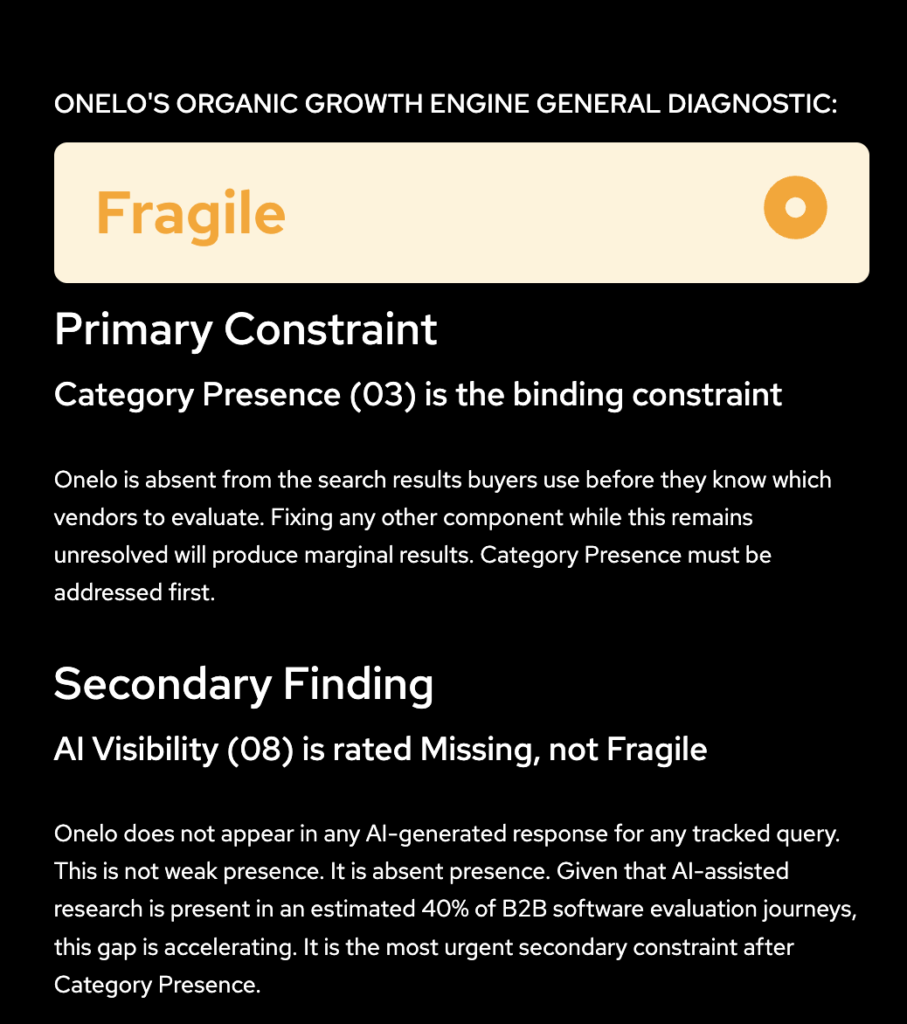
It contains three elements. The Executive Diagnosis is a three to four sentence plain-language summary of the primary finding: what is structurally preventing organic growth and what the causal chain looks like. It is written for a non-technical audience and connected to commercial consequences.
The System State Table shows all ten components in one view, each with its diagnostic state, intervention priority, and a one-line finding. It is ordered by intervention priority, not by component number. A founder reading this table for the first time knows within seconds which components are blocking growth, in what sequence they should be addressed, and what the single most important finding is for each.
The Constraint Chain Statement is the element that separates a system diagnosis from a list of findings. It explains how the blocking components interact with each other: why fixing one before another produces compounding improvement, and what becomes possible in the engine once the primary constraint is resolved.
| Why the constraint chain matters: Most organic growth problems look like a list of things to fix. The constraint chain reveals that they are not a list. They are a sequence. Addressing a downstream component before an upstream constraint is resolved wastes the intervention. The downstream fix either has no measurable effect or decays within weeks because the upstream problem continues to limit the system. The constraint chain tells the client which constraint to fix first, and specifically why that order produces compounding improvement rather than parallel activity with no structural logic. |
The Diagnostic Layer
The Diagnostic Layer is the full evidence section. One page per component, ten pages in total. It is where the depth of the diagnosis lives.
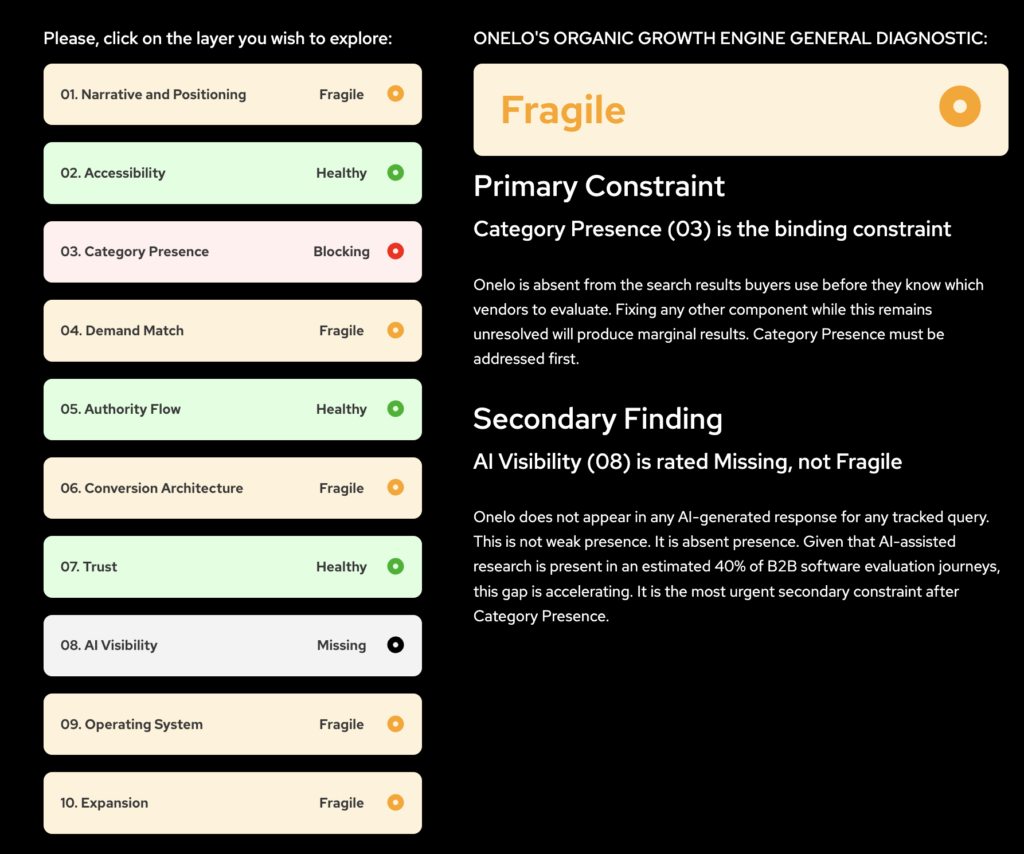
Each component page contains four elements. What was found describes the evidence in plain language, naming specific pages, specific queries, and specific metrics. Not ‘your landing pages have weak conversion architecture‘ but ‘your primary trial page receives 4,200 organic visits per month from queries indicating evaluation intent and converts at 0.8%, approximately one quarter of the benchmark for this query type and page purpose.’ Specificity is what distinguishes a structural diagnosis from an opinion.
Commercial stake connects each finding to a business consequence. Pipeline, CAC, competitive position, rate of compounding. A client reading this section should finish each page knowing what a finding costs them, not just what is technically wrong.
What fails at scale is the element that creates urgency without manufactured pressure. It describes what gets worse as the company grows if the constraint is not addressed. For a Demand Match failure, that might mean: as content investment scales, a larger budget produces more of the wrong traffic at higher cost. The misalignment compounds with investment. This section is often the most memorable part of the layer finding.
Healthy components still get a full page. A Healthy finding explains what is working and why, and notes what conditions could cause it to become fragile. This reinforces that the framework is a complete system assessment, not a list of problems.
The Intervention Sequence
The Intervention Sequence is the action plan. It translates the diagnosis into a prioritised list of specific changes, ordered by their position in the constraint chain, with enough context for a team to understand what needs to happen and why it happens in this order.
Each action item is defined by four fields: what specifically needs to change, why this item comes before others in the sequence (the causal reason, not just its rank), what success looks like as a specific observable outcome, and an estimated effort in person-days or weeks.
It opens with a brief explanation of the sequencing logic, written for the growth team: why the order matters, and why working through the Immediate priorities before the Near-term ones is not about difficulty but about causality. This explanation exists because teams naturally want to start with what feels most impactful, and the constraint-chain logic often produces a sequence that is counterintuitive.
The Intervention Sequence is also the section that makes the dossier practically shareable. A founder can share the Engine Health Summary with the board. A growth lead can work directly from the Intervention Sequence without needing to read the full Diagnostic Layer. The separation of diagnosis from action plan is what makes both sections useful to different people at different times.
Why This Is Not a Report
The comparison between a traditional audit report and the dossier is worth making explicit.
| A report | The dossier | |
| Format | A static document delivered at the end of the engagement. Captures a moment in time. | A persistent digital workspace with a unique URL per client. Lives and updates over time. |
| Structure | Findings presented in a consultant’s preferred order. No separation between diagnosis and action. | Four sections with distinct purposes and audiences. The diagnosis and the action plan are separate. |
| Language | Written for a consultant audience. Technical terminology, passive voice, hedged recommendations. | Written for a founder. Executive language. Commercial consequences. Active voice. Short sentences. |
| After delivery | Gets forwarded out of context. Recommendations get partially implemented. The engagement ends. | The founder returns to it. Uses it to brief new hires, update the board, onboard agencies. Layer states update as work progresses. |
| Accountability | None built in. The client either acts on recommendations or they do not. | Layer states remain visible. A founder who opens the dossier six weeks later and sees three blocking components still unchanged has a clear signal. Something needs to happen. |
The accountability mechanism is the most commercially significant difference. A report has no built-in accountability. Once it is delivered, whether the recommendations are acted on is entirely up to the client, and there is no structural mechanism to make the current state visible over time.
In the dossier, layer states are visible whenever the client opens it. A founder who opens their dossier six weeks after delivery and sees three blocking components still unchanged has an immediate and unambiguous signal. The diagnosis is still accurate. Nothing has moved. That signal is often the prompt that restarts the conversation, initiates a Build engagement, or re-energises a self-execution effort that had stalled.
The Dossier Lives, Not Files
A dossier moves through three states over the life of a client relationship.
- Diagnostic. The initial state at delivery. All four sections are populated. Layer states reflect the baseline diagnosis. This is the state every dossier launches in.
- Active. The client is executing the intervention sequence. Layer states are updated by the assessor as evidence of change accumulates. The dossier becomes a live record of progress, not a snapshot of a past moment.
- Reference. The organic growth engine has reached a stable state. Most components are at Healthy or Fragile, no blocking constraints remain. The dossier becomes a benchmark document: what the company looked like at diagnosis, what changed, and what to monitor going forward.
State changes are communicated to the client each time a component moves: Blocking to Fragile, Fragile to Healthy. Each update describes the evidence that confirms the change and what becomes possible now that this constraint has been reduced. Each update is a moment of recognised progress. A reason to return to the dossier. A signal that the relationship is still active even when no formal engagement is running.
The Dossier Is What the Client Buys
The diagnostic engagement is the process that produces the dossier. The four to six weeks of assessment work, the structured touchpoints with the founder and growth lead, the analysis across all ten components: all of it exists in service of producing a dossier that is specific, evidence-based, commercially grounded, and built to be used.
A client who completes a diagnostic engagement with Growth Forensics leaves with a clear model of why their organic growth engine is underperforming, a sequenced plan for addressing it, and a persistent workspace they can return to as the situation evolves. They do not leave with a document that summarises what they already knew.
| To see the dossier in practice: A demo dossier is available at organic.growthforensics.com. It is built around a demo company called OneIo and shows exactly what a completed dossier looks like: the Engine Health Summary, a selection of Diagnostic Layer pages, and the Intervention Sequence. The demo is not an onboarding flow. It does not collect email addresses. |