


A pattern I see repeatedly when running Organic Growth Diagnostics: a B2B SaaS company has grown its organic traffic, its paid spend is producing leads, and CAC is still creeping up quarter after quarter.
The team assumes the answer is more budget, better creatives, or a new channel. It rarely is.
High CAC in B2B SaaS is almost always a structural problem.
The acquisition system has a leak somewhere: targeting too broad, conversion too weak, activation too slow, or organic carrying less weight than it should. Cutting spend does not fix a structural problem. Diagnosing it does.
This guide walks through how to calculate CAC correctly, how to find where your specific leak is, and what to fix first.
The 90-day plan at the end is designed to be actionable without requiring a full go-to-market rebuild, and it will help you with cost optimization for your SaaS startup.
What is Customer Acquisition Cost (CAC)?
Customer Acquisition Cost (CAC) is the amount you spend to turn potential customers into a paying customer. In simple terms, CAC is all the costs of acquiring customers divided by how many customers you gained in the same period.
For B2B SaaS and PLG companies, this number has become harder to control. Paid search is more expensive, buying cycles are longer, and most deals now involve more stakeholders. Some reports show paid search CPCs rising from about $2.69 in 2021 to a projected $4.85 in 2026, an increase of roughly 80% (PaceAds). Many saas companies now see average customer acquisition cost for B2B SaaS companies typically ranges from $702 to $1,200 per customer, depending on marketing strategies, ACV, and industry competition.
That does not mean every high CAC is bad. A good customer acquisition cost is one that is lower than the lifetime value of a customer, ensuring that the business remains profitable over time. The ideal LTV to CAC ratio is widely accepted to be 3:1, meaning for every dollar spent on acquiring a customer, the business should expect to earn three dollars in return over the customer’s lifetime. CAC payback also matters: many SaaS teams aim for payback in under 12–18 months, depending on ACV and sales motion.
This guide is a practical playbook on how to reduce customer acquisition cost: calculate customer acquisition cost correctly, diagnose the leak, and then improve paid, organic, and product-led growth systems.
From Growth Forensics’ perspective, this article assumes a subscription business with recurring revenue. We work with B2B SaaS teams where organic traffic, SEO, content, CRO, and onboarding are expected to become serious acquisition channels, not just “brand activity.”
How to Calculate Customer Acquisition Cost (CAC) Correctly
Before you can reduce customer acquisition costs, you need a clean calculation. Customer acquisition cost (CAC) is calculated by dividing the total costs spent on acquiring new customers by the number of customers acquired in the same time period.
Formula:
CAC = total acquisition sales and marketing spend ÷ new paying customers acquired
If Q1 marketing and sales expenses were $240,000 and you won 400 new customers, CAC is:
$240,000 ÷ 400 = $600
If that $240,000 includes $90,000 in google ads, $40,000 in content and agency work, $85,000 in sales costs, and $25,000 in marketing tools and events, the calculation is more useful because it reflects the real acquisition process. Search dashboards may call this customer acquisition cost cac, cost per acquisition, or cost per customer, but the principle is the same: include the relevant costs and divide by customers acquired.
| Include in CAC | Usually exclude from CAC |
| ad spend, advertising costs, google ads campaigns, LinkedIn spend, paid campaigns | Pure support work after purchase |
| SDR/AE salaries, commissions, sales expenses, sales reps, sales team tools | Product development unrelated to acquisition |
| agencies, content production, events, marketing costs, marketing expenses | Finance, legal, and general admin unless allocated |
| marketing automation tools, landing page software, webinar tools | Customer Success costs used only for customer retention |
Grey areas need judgment. Referral programs, advocacy, UGC and influencer partnerships, and loyalty programs can support both customer acquisition and customer retention. If a program helps existing customers stay longer and also brings more customers, split the cost instead of forcing it into one bucket.
You should also calculate CAC by marketing channels. Separate CAC for SEO, outbound, google ads, paid social, events, and partner marketing campaigns. Then go deeper by campaign, audience, and keyword theme. A blended CAC may look acceptable while one channel is quietly wasting the acquisition budget.
Track CAC with adjacent key metrics: customer lifetime value, CAC payback period, LTV:CAC ratio, monthly revenue per cohort, and blended versus channel CAC. A good customer acquisition cost cannot be judged without lifetime value, gross margin, and churn.
Diagnose the Real Drivers of High CAC Before Cutting Spend
Reducing CAC is not the same as spending money more slowly. A team can cut ad spend by 30% and still have a weak customer acquisition strategy if targeting, positioning, conversion, or activation is broken.
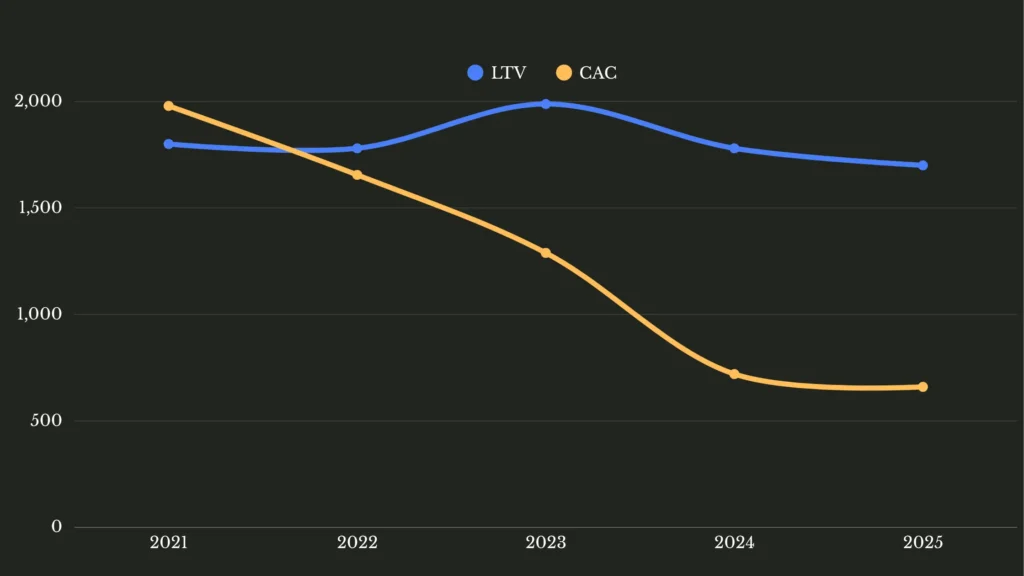
Use a fixed recent window, such as the last 90 days for PLG or the last six months for enterprise sales, and diagnose the funnel before changing the budget.
Start with this sequence:
- Segment CAC by channel: paid search, paid social, SEO, outbound, referral, partner, and direct.
- Segment by ICP, ACV band, use case, company size, and deal size.
- Check conversion rates through the marketing funnel: impressions → clicks → leads → trials or SQLs → opportunities → closed customers.
- Overlay customer lifetime value by segment so you do not cut a high-CAC segment that produces valuable customers.
For example, a SaaS startup may see CAC above $1,200 from google ads. At first, the problem looks like expensive traffic. But the data shows that trials are coming in, while only 5% activate because onboarding is confusing and the first value moment takes too long. In that case, the fastest route to lower cac is not a cheaper keyword. It is fixing activation.
I call this the binding constraint. It is the narrowest part of the organic growth engine: traffic quality, conversion, activation, monetisation, or retention. If traffic is healthy but landing pages are weak, scale traffic later. If signups are healthy but activation is poor, fix onboarding before scaling paid spend.
Improve Targeting and Messaging to Lower CAC at the Source
Misaligned targeting and generic messaging are often the biggest hidden drivers of high acquisition costs. If the target audience is too broad, every click, demo, and SDR touch becomes less efficient.
Use customer data to tighten your ICP around customers with high LTV, fast payback, low support burden, strong retention, and clear product-market fit. Retaining an existing customer costs significantly less than acquiring a new one, so do not define “best customer” only by first contract size. Define it by customer lifetime, expansion, and support effort.
Then build better market information:
- Interview 10–20 of your best customers and ask what triggered the search, what alternatives they considered, and what nearly stopped them buying.
- Pull exact phrases from those interviews into personalized messaging, ad copy, landing pages, sales tactics, and outbound scripts.
- Segment campaigns by problem, industry, and role. “B2B SaaS analytics for Series B–E product teams” is more precise than “analytics software.”
- Use predictive segmentation when volume allows: industry, ACV band, pricing-page visits, integration-page visits, trial usage, and high-intent searches.
- Use lookalike audiences from high-LTV customers; refining audience targeting and utilizing lookalike audiences can enhance marketing efficiency.
Personalization is not cosmetic. Personalization can reduce customer acquisition costs by as much as 50%, lift revenues by 5–15%, and increase marketing spend efficiency by 10–30%. Companies that excel in personalization achieve compound annual growth rates 10% higher than those that do not, with only 10% of companies qualifying as leaders in this area, according to McKinsey.
AI-driven personalization allows businesses to focus resources on accounts with a high probability of conversion, significantly improving lead quality and reducing acquisition costs. AI-driven personalization can reduce customer acquisition costs (CAC) by as much as 50%, while also improving lead quality and conversion rates.
Personalization strategies, such as tailored product recommendations and targeted messaging, can streamline the customer journey and enhance conversion rates, leading to lower acquisition costs. Implementing predictive segmentation techniques allows marketers to target specific audiences with higher conversion potential, which can significantly lower CAC.
This applies to organic channels too. Organic SaaS content marketing that solves specific user pain points can effectively attract high-intent traffic. Instead of broad “SaaS marketing tips,” build content for jobs-to-be-done, decision-maker roles, and buying process questions.
Use Paid Channels More Efficiently (Without Over-Relying on Them)
Paid media is usually where CAC explosions appear first. That makes it a useful place to find waste, but a dangerous place to rely on forever.
- Set up first-party tracking, conversion events, and revenue import before optimizing bids. If platforms only see form fills, they may optimize for cheap leads instead of higher quality customers.
- Build a 30–60 day baseline by campaign and network: Search, Performance Max, Display, paid social, and retargeting. Compare CPL, SQL rate, win rate, and true acquisition costs.
- Separate high-intent keywords from research terms. “Best SOC 2 compliance software pricing” should not be treated like “what is SOC 2.”
- Use dedicated landing pages for each major campaign theme. Keep one primary CTA and match the keyword, ad, page headline, proof, and offer.
- Exclude poor placements and geographies where you cannot sell or support. Bad inventory can make marketing success look like activity while business health gets worse.
- Test 2–3 ad variants at a time. Rotate headlines, proof points, offers, and visuals, then pause underperformers.
- Retargeting with hyper-personalized online ads can lead to a substantial reduction in CAC by focusing ad spend on users with the highest likelihood of conversion.
- UGC and influencer partnerships can lower production costs and increase engagement, especially when the audience trusts practitioners more than polished brand campaigns.
As organic growth improves blended CAC, you can often move budget away from hyper-competitive head terms into long-tail search, remarketing, partner campaigns, and expansion plays. This is how you lower your customer acquisition without starving the pipeline.
Fix Landing Pages and On-Site Conversion Before Adding More Traffic
Poor conversion architecture turns every click into a tax. If landing pages are unclear, slow, or generic, marketing teams keep buying attention that the website fails to convert.
High-performing SaaS landing pages usually include:
- A sharp positioning statement: what the product does and who it is for.
- A clear value proposition tied to a painful business outcome.
- Social proof: logos, short case snippets, customer quotes, or usage numbers.
- Risk reducers: free trial, self-serve demo, security proof, implementation support, or guarantee.
- One primary CTA and minimal distractions.
Run a 30-day CRO sprint before increasing spend. Use analytics, heatmaps, session recordings, and google analytics data to identify where visitors leave. Prioritize the homepage, high-traffic landing pages, integration pages, and pricing pages.
Useful tests include reducing form fields, clarifying pricing tiers, adding implementation timelines, and adding “who it’s for / who it’s not for” sections. Clear and transparent pricing can significantly enhance customer trust and self-qualification, leading to higher conversion rates.
Simplifying pricing structures, such as reducing the number of tiers and using labels like “most popular,” can lead to increased conversion rates and average deal sizes. Transparent pricing acts as a natural filter, attracting leads that align with the product’s value and budget, thus improving lead quality.
Speed and UX matter as much as copy. Slow pages, confusing navigation, broken mobile layouts, and unclear forms push CAC up because visitors leave before they understand the offer. Optimizing a website’s conversion rates can help in attracting higher-quality leads and sustainably lowering CAC.
Message consistency is the final check. If google ads promise “reduce trial churn” but the landing page talks about generic “better analytics,” you create doubt at the exact moment you need trust.
Build an Organic Growth Engine to Reduce CAC Over Time
For many B2B SaaS companies, customer acquisition becomes unsustainably expensive when the model depends only on paid channels. Organic channels such as SEO, content, referrals, brand, and product-led loops are what bring blended CAC down over 12–36 months. Customer Acquisition Cost (CAC) can be lowered by shifting focus from top-of-funnel advertising to building organic growth loops.
SaaS SEO and content marketing are powerful tools for reducing customer acquisition costs (CAC) over time, as content continues to generate leads for 12+ months after publication, creating a compounding effect. Content marketing is typically 62% cheaper than traditional marketing approaches and generates three times as many leads for the same spend, making it a cost effective strategy for businesses. Companies that invest in strong organic and referral channels often see their “Blended CAC” drop by 30–50% compared to relying solely on paid strategies, highlighting the effectiveness of SEO and content marketing.
A practical organic engine includes:
- Researching problem-space keywords and solution-space keywords.
- Building topic clusters around core pains, not random blog topics.
- Creating integration, use-case, comparison, and industry landing pages.
- Using in-depth guides, ROI calculators, templates, and self-serve demos as soft CTAs.
- Mapping content to problem awareness, solution comparison, and vendor selection.
- Creating educational content that improves customer experience after signup.
Programmatic or templatized landing pages have been a major SaaS growth pattern across the 2010s and 2020s: integration pages, template libraries, comparison hubs, and use-case pages can attract buyers long before they want to speak to sales. This can also work for an ecommerce business, but in SaaS the compounding effect is especially powerful because recurring revenue makes each organic conversion more valuable.
Referral programs also deserve attention. Referral programs can reduce customer acquisition costs (CAC) by 15% compared to traditional paid advertising methods, as they leverage the trust customers have in their personal networks. Customers acquired through referral programs are 4 times more likely to make a purchase and tend to spend 34% more on average than those acquired through other channels. Implementing a referral program can lead to exponential growth through “viral loops,” where each new customer can potentially bring in more customers, significantly enhancing overall acquisition efforts.
When I diagnose an organic growth engine, the assessment covers content quality, authority flow, conversion architecture, and demand match before recommending any increase in output. The goal is to find the structural constraint preventing commercial outcomes, not just traffic growth.
Leverage Automation, Product-Led Onboarding, and Retention to Bend the CAC Curve
Once targeting and acquisition mechanics are in place, the fastest way to lower customer acquisition costs is often to improve conversion, activation, retention, and expansion.
- Marketing automation helps route effort where it matters. Define your ICP, score leads based on customer behavior such as pricing-page visits, trial signups, integration interest, and product usage, then send only high value prospects to sales reps. Companies leveraging marketing automation report a 12.2% drop in marketing overhead costs and a 14.5% boost in sales productivity. Marketers using automation to nurture prospects see a 451% increase in quality leads, significantly improving lead quality and conversion rates.
- Automated nurture can include 7–10 day email campaigns, role-based tracks for founders versus RevOps leaders, lifecycle retargeting, and alerts when a trial user reaches a buying signal. Automating lead scoring and nurturing can shorten your sales cycle by about 25%, resulting in a 30% quicker CAC payback period.
- Product-led onboarding reduces reliance on expensive 1:1 demos. Use self-serve signup, in-app tours, activation checklists, contextual help, and clear upgrade paths. Define Product Qualified Leads based on meaningful usage, not vanity events, because PQLs usually convert better than cold demo requests.
- Retention changes the economics. Improving customer retention can significantly enhance the customer lifetime value, as a 5% increase in retention can lead to profit increases of 25–95%, depending on the business model. Retaining an existing customer costs significantly less than acquiring a new one, so retention is part of acquisition efficiency.
- Expansion increases revenue without restarting the acquisition process. Upsells, seat expansion, add-ons, customer education, and value reviews increase revenue per account and improve effective CAC per dollar of ARR.
The best SaaS teams manage the whole customer lifecycle. They do not stop measuring after the lead becomes a customer. They watch activation, usage, expansion, support load, churn risk, and referral potential.
Putting It All Together: A 90-Day Plan to Reduce Customer Acquisition Costs
You do not need to rebuild the entire go-to-market system at once. Start with diagnosis, fix the biggest leaks, and then invest in compounding channels.
First 30 days:
- Calculate current CAC accurately, blended and by channel.
- Include all the costs: marketing spend, sales expenses, tools, agencies, events, and commissions.
- Map funnel conversion rates from click to closed customer.
- Segment by ICP, ACV, and customer lifetime value.
- Run a light organic growth diagnostic across content quality, authority flow, conversion paths, and demand match.
- Identify the biggest leak: weak targeting, low landing-page conversion, poor activation, or low retention.
Days 31–60:
- Tighten keywords, placements, geographies, and offers in paid campaigns.
- Improve message match across ads, landing pages, and sales follow-up.
- Launch 2–3 CRO tests on pricing pages and high-traffic acquisition pages.
- Interview best customers and update personalized messaging.
- Start lead scoring, nurture flows, and sales routing rules so the sales team focuses on the right accounts.
Days 61–90:
- Build Enterprise SEO topic clusters, comparison content, and programmatic landing pages.
- Strengthen blog and resource content around specific pain points.
- Roll out onboarding flows, activation checklists, and lifecycle email campaigns.
- Add simple retention and expansion plays: value reviews, product education, and feature adoption prompts.
- Review budget allocation and move spend toward channels producing profitable acquisition.
Track a small weekly dashboard: CAC by channel, trial-to-customer conversion, activation rate, time to first value, early churn, ACV, expansion signals, and LTV:CAC. These key metrics show whether marketing efforts are producing compounding growth or just generating leads.
Reducing customer acquisition cost in B2B SaaS sustainably comes from structural improvements: sharper targeting, stronger organic growth, better conversion, faster activation, and higher LTV. Cutting budget reduces short-term spend. Fixing the structural constraint is what improves the economics of growth.
If organic is already a primary channel, or should become one, the most useful first step is diagnosing whether the engine has a structural constraint before investing further in output or spend.