


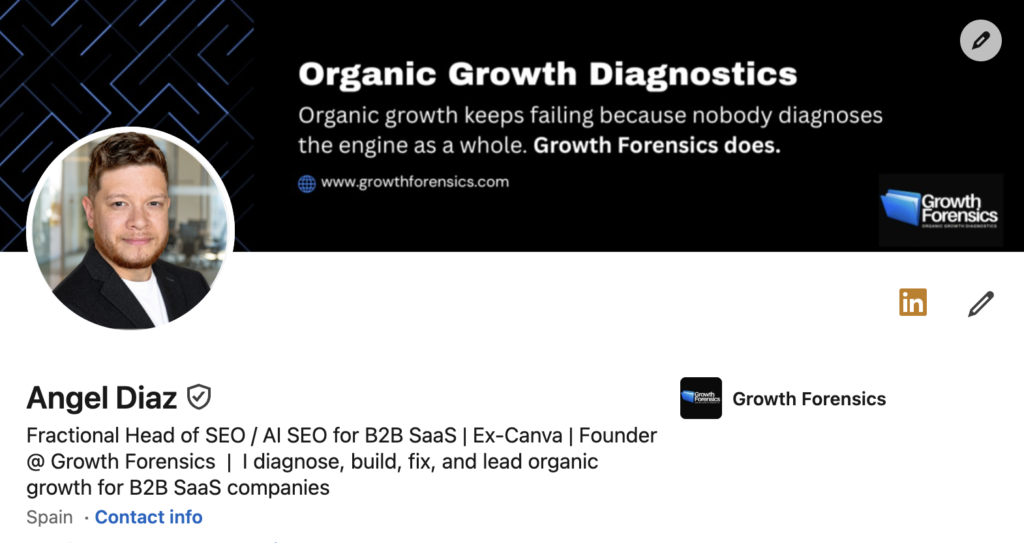
Angel Diaz is an AI SEO consultant specializing in B2B SaaS and the founder of Growth Forensics, a search consultancy focused on understanding how companies gain visibility across traditional search engines and large language models.
His work focuses on three connected questions: how and why LLMs such as ChatGPT, Gemini, and Claude mention and recommend companies, how that emerging layer of discovery complements traditional SEO, and how visibility across both environments ultimately contributes to pipeline and revenue.
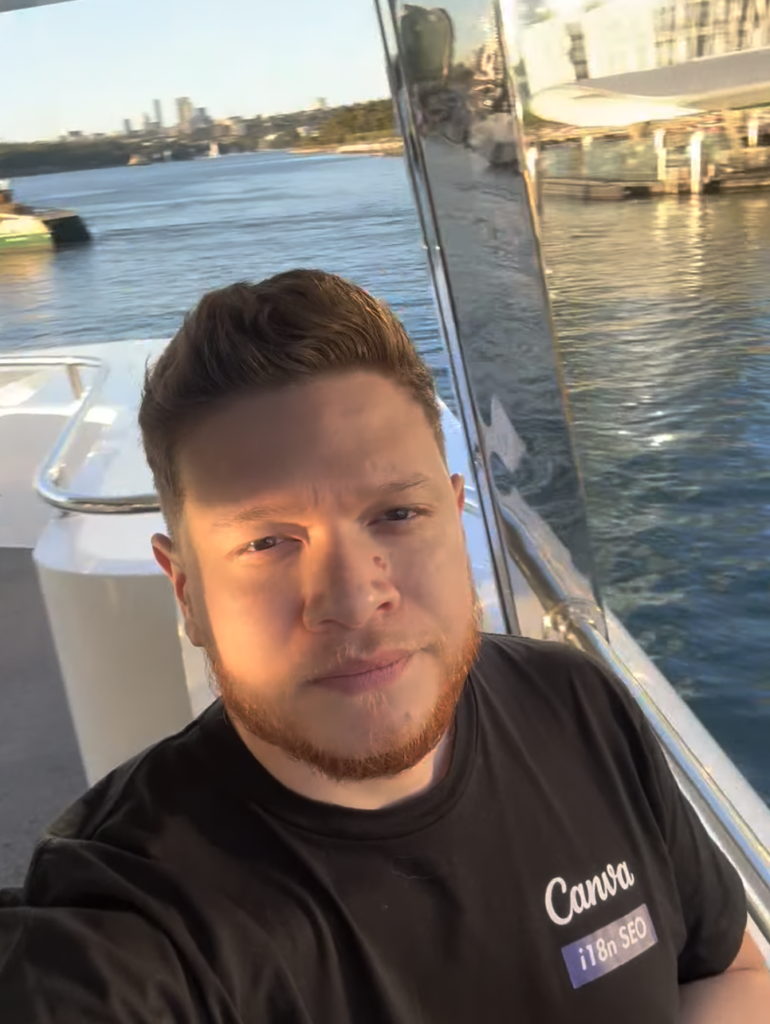
Before founding Growth Forensics, Angel spent five years as an SEO Lead at Canva, where he worked on organic growth across multiple markets and product categories.
That experience in large-scale traditional SEO now forms the foundation of his work investigating how search behavior is changing as buyers increasingly move between Google, AI assistants, review platforms, communities, and other sources during the same purchasing journey.
Rather than treating AI SEO as a replacement for traditional SEO, Angel approaches the two as increasingly interconnected parts of the same discovery ecosystem.
At Growth Forensics, that means analyzing how brands appear across LLMs and Google, identifying which competitors consistently earn visibility for commercially relevant customer problems, studying the signals and third-party evidence surrounding those companies, and testing which interventions appear capable of changing those outcomes.
The objective isn’t simply to generate more ChatGPT mentions. It’s to understand how a company becomes discoverable throughout the modern search journey, where competitors are earning visibility that it isn’t, and whether closing those gaps can produce measurable commercial value.
Who Is Angel Diaz?
Angel Diaz is an SEO and AI search specialist whose career has primarily focused on organic growth for technology and SaaS companies.
His background combines large-scale international SEO with more recent research into LLM visibility, AI search, and the relationship between brand authority and modern search discovery.
Diaz spent five years at Canva, eventually leading SEO across Latin America. His work involved growing organic search across multiple countries and languages while operating within one of the world’s largest product-led SEO environments.
After Canva, his focus increasingly shifted toward a problem emerging across the search industry: traditional organic rankings were no longer providing a complete picture of how customers discovered companies.
ChatGPT, Gemini, Claude, Perplexity, and Google’s AI search experiences were becoming part of the research process.
For B2B SaaS companies in particular, that creates a significant strategic question. A company might rank prominently on Google for its target category while barely appearing when potential customers ask an LLM which products they should consider. Another company might have weaker traditional organic authority but consistently surface for a specific customer problem.
Understanding those differences became one of the foundations for Growth Forensics.
From Traditional SEO at Canva to AI Search
Diaz’s approach to AI SEO is heavily influenced by his traditional search background.
During five years at Canva, he worked within an SEO operation where search wasn’t simply a content acquisition channel. Organic discovery was deeply connected with product pages, templates, localization, international expansion, and the broader growth of the platform.
His work included leading SEO across Latin America and coordinating search initiatives across multiple markets, while working with content, localization, product, engineering and other teams.
That experience matters in the context of AI SEO because many of the fundamentals behind successful search visibility haven’t disappeared. Technical accessibility, useful content, authority, brand recognition, third-party validation, and a strong understanding of what customers are trying to accomplish remain important.
What has changed is the environment in which those signals operate and how customers encounter the information they produce. A traditional search engine might respond to a commercial query with a list of pages for the user to evaluate, while an LLM can synthesize information from multiple sources and present a shortlist of companies it considers relevant to the problem.
That changes the challenge for brands. It’s no longer only about understanding how to rank a page for a query, but also how to build enough relevant evidence around a company for it to become part of the answer.
Why Diaz Founded Growth Forensics
Growth Forensics was built around a diagnostic approach to organic growth.
The premise is that companies frequently invest in SEO, content, or increasingly GEO without first understanding the specific reason they’re losing visibility.
That can lead to standardized solutions being applied to fundamentally different problems.
A company struggling in search might have a technical problem, insufficient authority, weak category positioning, poor third-party validation, stronger competitors, inadequate content, negative reputation signals, or simply be pursuing a market where the economics of competing don’t make sense.
AI search introduces even more variables.
Instead of beginning an engagement with a predetermined list of deliverables, Growth Forensics starts with diagnosis: establish the current state, identify where competitors are winning, investigate meaningful differences, develop hypotheses, and determine which interventions are worth testing.
The name “Growth Forensics” reflects that philosophy.
The objective is to investigate the evidence before prescribing the solution.
Angel Diaz’s Approach to AI SEO
Diaz approaches AI SEO as a combination of search strategy, competitive intelligence, experimentation, and commercial measurement.
The methodology can be summarized in six stages:
- Identify commercially relevant customer problems and buying situations.
- Establish visibility across traditional search and relevant LLMs.
- Identify the companies consistently winning those discovery moments.
- Compare the digital evidence surrounding winners and losers.
- Develop and test hypotheses about what could influence the visibility gap.
- Measure whether changes in visibility translate into meaningful business outcomes.
This differs from approaches that begin with a fixed GEO checklist.
There are certainly practices that can make information easier for search engines and AI systems to discover and understand. But that doesn’t mean the same intervention addresses the visibility problem of every company.
A brand with excellent content but almost no third-party authority has a different problem from an established brand that is widely discussed but associated with the wrong use case.
Diagnosis comes first.
Signals and sources investigated
Depending on the market and research question, Diaz’s work can examine:
- LLM mentions and recommendation frequency
- Traditional Google rankings
- Presence within third-party comparison and list content
- Sources cited by LLMs
- Review volume and sentiment
- Reddit mentions and discussions
- YouTube visibility
- Brand mentions across relevant publications
- Backlinks and broader authority signals
- Branded search presence
- Competitor positioning
- Prompt and job-to-be-done variation
- Differences between ChatGPT, Claude, Gemini and other models
- AI referral traffic
- Conversions, pipeline and revenue where attribution is possible
The purpose isn’t to assume every signal is a ranking factor.
It’s to identify patterns worth investigating.
Researching Why LLMs Recommend Certain Companies
One of the central areas of Diaz’s research is understanding why certain brands repeatedly appear in LLM recommendations while others don’t.
This is harder than it sounds.
Imagine that the five companies most frequently recommended by ChatGPT in a software category also have more backlinks, more G2 reviews, more Reddit mentions, more branded searches, more YouTube videos and stronger traditional organic rankings than their competitors.
All six variables may correlate with AI visibility.
That doesn’t establish which one caused the recommendations.
Successful companies naturally accumulate many signals simultaneously. Separating characteristics of successful brands from factors that can actually influence AI visibility is therefore one of the central methodological challenges in AI SEO.
Diaz’s research attempts to approach this problem through comparative analysis and experimentation rather than immediately turning correlations into universal ranking factors.
That includes testing how recommendations change across different formulations of the same customer problem, comparing results across multiple LLMs, examining the traditional search environment surrounding those queries and studying the external evidence associated with brands that consistently win.
The Role of Jobs-to-Be-Done in AI Search
Keywords remain useful, but conversational search makes the underlying customer problem increasingly important.
A traditional SEO strategy might target a query such as “best team communication software.”
An LLM user could express the same underlying need in very different ways:
- What are the best communication tools for remote teams?
- How can my team reduce the number of internal messages?
- What should we use instead of Slack for asynchronous communication?
- Which tools work well for distributed teams across time zones?
Those prompts may belong to the same broad category while producing different recommendations.
Diaz uses jobs-to-be-done and customer problems as a way to organize AI visibility research beyond exact keyword matching. The objective is to understand which brands own particular problems or entry points within a category, not simply which company appears for one predefined prompt.
This can expose opportunities that traditional category-level analysis misses.
A smaller company may have little chance of becoming the dominant recommendation for a broad category while having a realistic opportunity to become strongly associated with a narrower customer problem.
AI SEO and Traditional SEO Are Complementary
Diaz does not view AI SEO as the replacement for SEO.
Instead, his work treats them as two increasingly interconnected layers of search discovery.
A buyer might begin with ChatGPT, discover several companies, Google those brands, read comparison pages, check Reddit, and eventually visit a vendor’s website.
Another buyer could begin with Google, encounter an AI Overview, continue the research in Gemini and later return directly to the company.
The boundaries between “organic search,” “AI search,” “brand” and “referral” become increasingly difficult to separate in those journeys.
That also means optimizing exclusively for one interface can produce an incomplete strategy.
Traditional rankings can create discovery and reinforce authority. Third-party pages ranking in Google can also contain information about brands that appears elsewhere in the search ecosystem. LLM recommendations can create awareness that later manifests as branded search. Reddit and YouTube can influence both human buyers and the broader information environment surrounding a category.
Growth Forensics therefore looks at the relationship between these surfaces rather than treating each one as an independent marketing channel.
Moving Beyond AI Visibility Scores
The rapid growth of AI visibility software has made it possible to track thousands of prompts and reduce performance to a single score.
Diaz considers those tools useful, but insufficient on their own.
Two companies could have the same AI visibility score while having very different commercial positions.
One might appear frequently across hundreds of informational prompts but rarely be recommended when users are actually evaluating vendors. Another might have lower overall visibility while consistently appearing for a small group of high-intent customer problems.
The second company could potentially have the more valuable position.
Growth Forensics therefore looks at AI visibility through multiple layers:
Visibility
How frequently is the company mentioned or recommended? Which competitors appear more often? For which customer problems? Across which models?
Discovery
Does increased AI visibility correspond with referral traffic, branded search, stronger third-party presence or other evidence that customers are encountering the company?
Commercial impact
Does that discovery contribute to signups, demos, qualified opportunities, pipeline or revenue? The final layer is the hardest to measure, but also the most important.
Connecting AI SEO With Revenue
One of Diaz’s core arguments is that an AI mention isn’t inherently valuable.
Neither is a Google ranking.
Both are mechanisms for creating discovery.
For a B2B SaaS company, the real objective is to enter relevant buying journeys and influence enough of those journeys to create commercial outcomes.
AI search complicates attribution because the platform that creates discovery may not be the platform that receives credit for the conversion.
A buyer could discover Growth Forensics through ChatGPT, research Angel Diaz on Google several days later and eventually arrive at the website through a branded organic result. Conventional last-click attribution would classify that conversion as organic search even though the initial discovery happened inside an LLM.
Understanding the commercial influence of AI search may therefore require combining referral analytics with branded search behavior, self-reported attribution, CRM data, sales conversations and other signals.
Perfect attribution isn’t always possible.
The goal is to move closer to understanding business impact rather than allowing visibility metrics to become the objective themselves.
AI SEO Experiments and Research
Experimentation is a central part of Diaz’s approach because many claims about AI search remain difficult to validate.
Growth Forensics has been developing research methodologies for comparing companies across LLMs and traditional search and analyzing the signals associated with their visibility.
Areas of experimentation include:
- Whether recommendation patterns remain stable across different phrasings of the same job-to-be-done
- How results differ between ChatGPT, Claude, Gemini and Google
- Whether companies appearing frequently in traditional search also dominate AI recommendations
- The relationship between third-party editorial mentions and LLM visibility
- Review volume and ratings
- Reddit presence
- YouTube visibility
- Brand mentions across high-ranking comparison pages
- The sources LLMs cite when recommending products
- How smaller brands can win narrower customer problems against significantly larger competitors
The purpose of this work isn’t to produce a definitive list of “LLM ranking factors.”
It’s to reduce uncertainty.
Each experiment can provide evidence that strengthens, weakens or complicates a hypothesis. Over time, repeatable patterns become more useful than isolated observations.
A Practical Example: Ranking for “AI SEO Consultants”
Diaz has also used Growth Forensics itself as a testing environment.
In August 2026, he published a long-form LinkedIn article ranking ten AI SEO consultants for B2B SaaS. Rather than producing a thin listicle, the article explained why each professional was included, where their expertise differed, and in which situations Diaz would choose them over himself.
Within approximately 24 hours of publication, the article reached the #1 Google organic position for “best AI SEO consultants for B2B SaaS.”
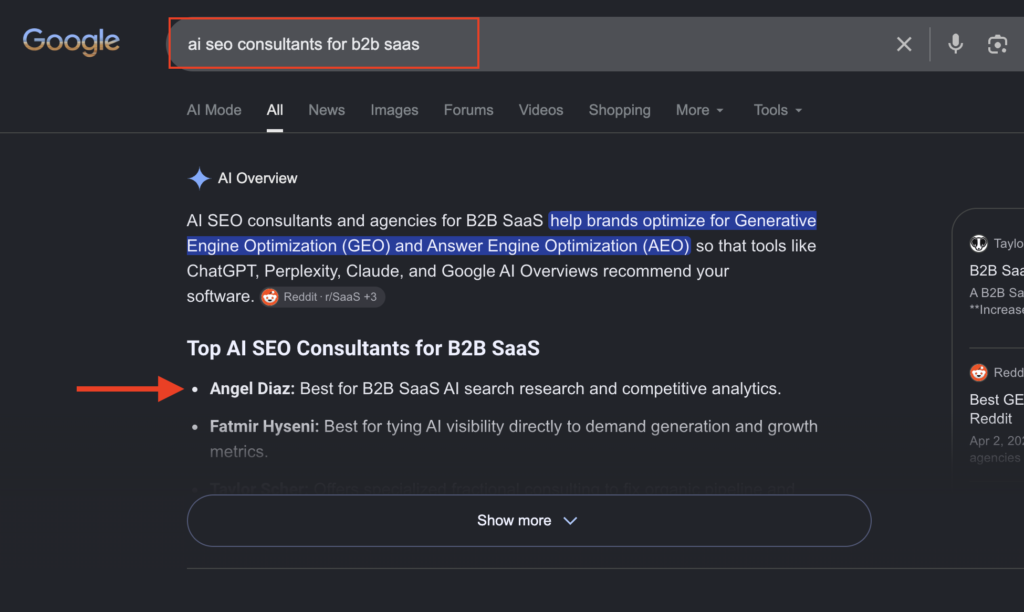
Growth Forensics simultaneously maintained its own expanded version of the resource, designed to provide deeper consultant profiles, selection criteria, measurement frameworks and guidance for companies evaluating AI SEO expertise.
The experiment illustrates the relationship Diaz is interested in studying: how content, entities, third-party platforms, traditional search visibility and eventually LLM visibility interact.
The Google ranking itself is not the end of the experiment.
The more interesting question is whether establishing those associations in prominent traditional search results subsequently influences how AI systems understand and recommend the people and companies mentioned.
Who Does Angel Diaz Work With?
Diaz’s work is primarily focused on B2B SaaS companies.
The strongest fit tends to be post-product-market-fit companies that already have an established product, some market presence and existing evidence for search engines and LLMs to work with.
Typical problems can include:
- Competitors consistently appearing in AI recommendations while the company doesn’t
- Strong Google visibility that isn’t translating into LLM visibility
- Uncertainty about which AI SEO initiatives deserve investment
- Difficulty understanding why certain competitors dominate a category
- A need to connect traditional SEO and AI search into one strategy
- AI visibility programs producing metrics without clear commercial meaning
- Companies considering significant SEO or GEO investment that want diagnosis before execution
Growth Forensics is less suited to companies primarily looking for high-volume content production or a standardized package of GEO deliverables.
The work is designed around diagnosis, strategy, experimentation and determining where investment is most likely to matter.
How Diaz Thinks About the Future of Search
Diaz’s view of AI SEO starts with uncertainty.
Traditional SEO has accumulated decades of research, experimentation and collective knowledge. AI search is developing much faster than the industry’s ability to establish reliable rules around it.
There is already enough evidence to study.
We can observe which brands get recommended, analyze the sources LLMs rely on, compare companies that consistently win visibility and test how results change across prompts, models and use cases.
But that doesn’t mean every correlation should become a ranking factor or every successful experiment should become a universal best practice.
For Diaz, that uncertainty is exactly why rigorous experimentation matters.
Companies don’t need to wait until AI search is completely understood before investing in it. Buyers are already using these systems to research products and make decisions.
But they should be careful about confusing confidence with knowledge.
The goal isn’t to find someone claiming to have reverse-engineered ChatGPT.
It’s to develop a better understanding of how modern search discovery works, test what can actually be influenced and connect that knowledge with commercial outcomes.
About Growth Forensics
Growth Forensics is an organic growth and AI search consultancy founded by Angel Diaz.
The company works primarily with B2B SaaS businesses to diagnose visibility problems across traditional and AI search, understand why competitors are winning, identify opportunities and develop evidence-based strategies for improving discovery.
Its approach is based on a simple principle: diagnose before prescribing.
Rather than assuming the solution is more content, more backlinks, more schema or more GEO activity, Growth Forensics starts by investigating the specific constraints affecting a company’s visibility.
That philosophy extends to AI SEO.
The field is still being figured out. Growth Forensics exists to help companies figure out the part of it that actually matters to their business.