


AI SEO has gone from a niche topic to an increasingly important part of search strategy remarkably quickly. Buyers are still using Google, but they’re also asking ChatGPT, Gemini, Claude, Perplexity and other AI systems to recommend products, compare vendors and help them make purchasing decisions. For B2B SaaS companies, that creates a new visibility problem.
Ranking on Google still matters. However, a company can perform well in traditional search and barely appear when potential customers ask an LLM for recommendations.
The opposite can happen too: smaller brands can earn surprisingly strong visibility for specific problems or use cases despite having nowhere near the traditional search authority of the category leaders.
The challenge is understanding why.
AI SEO is still a young discipline. We don’t have anything close to the two decades of research, tooling and collective knowledge that exists around traditional SEO. There are useful observations, emerging patterns and increasingly sophisticated experiments, but there is also a lot of certainty being attached to things we don’t fully understand yet.
That makes choosing an AI SEO consultant harder than it should be.
There are now hundreds of people describing themselves as AI SEO, GEO, AEO or LLM optimization experts. Some have spent years working in search and are genuinely trying to understand how discovery is changing. Others are essentially selling the same SEO service with a new acronym attached to it.
This list is intended to help separate the two.
Quick Summary: Best AI SEO Consultants for B2B SaaS in 2026
If you don’t want to read all ten profiles, here’s the short version. Each consultant brings a different strength to AI SEO, so the best choice depends on the problem you’re actually trying to solve.
| # | Consultant | Best for | Key strength |
|---|---|---|---|
| 1 | Angel Diaz, Growth Forensics Founder | B2B SaaS AI SEO research and competitive diagnostics | Connecting LLM visibility, traditional SEO and revenue |
| 2 | Fatmir Hyseni | AI search combined with B2B demand generation | Growth strategy, measurement and attribution |
| 3 | Juan Carlos Trueba Santana, Volcanz Digital | Spain and Spanish-speaking markets | International SEO, technical SEO and GEO |
| 4 | Ann Smarty, Smarty.Marketing | Building the off-site authority that supports AI visibility | Reddit, digital PR and brand mentions |
| 5 | Kenan Mujezinovic | Scaling SEO through AI and automation | Programmatic SEO and automated SEO workflows |
| 6 | Cornel Manu | Connecting AI visibility directly with B2B SaaS pipeline | SEO/GEO, CRO and full-funnel growth |
| 7 | Gert Mellak, SEOLeverage | Visibility across the entire search journey | Google, AI platforms, Reddit and YouTube |
| 8 | Wayne Burden, Alchemy | Larger and technically complex SEO programs | Technical SEO, AI search and integrated organic strategy |
| 9 | Paul Teitelman, Paul Teitelman SEO Consulting | Bringing established SEO programs into AI search | 18+ years of SEO combined with GEO and AEO |
| 10 | Austin Furey, New Chemistry | B2B AI search tied to GTM and demand generation | Prompt strategy, ABM and revenue attribution |
How I Selected the Consultants
This isn’t a ranking based on LinkedIn follower counts, personal brand size or who publishes the most content about GEO.
I looked for consultants with different combinations of:
- Established search experience: A strong understanding of SEO and how search has evolved, rather than treating AI search as something completely disconnected from everything that came before it.
- Active work in AI search: Evidence that they’re actually working on GEO, AEO, LLM visibility or related problems today.
- Original thinking or experimentation: People developing methodologies, conducting research, building systems or otherwise contributing something beyond repeating commonly accepted AI SEO advice.
- B2B and SaaS relevance: Experience that translates particularly well to companies with longer buying journeys, complex products and commercially valuable search demand.
- A broader view of visibility: An understanding that what happens outside a company’s website can be just as important as what happens on it.
- Commercial thinking: The ability to connect search visibility with business outcomes rather than treating mentions, citations or rankings as the end goal.
- A clear reason to hire them: Every person on this list has an area where I think they’re particularly strong.
That last criterion is important.
I don’t think there’s an objectively “best” AI SEO consultant for every company. Someone with deep expertise in Reddit and digital PR may be a much better choice for one problem, while another company might need technical SEO, programmatic execution, international expertise, demand generation, or sophisticated attribution.
So rather than giving you ten names and pretending they’re interchangeable, I’ve tried to answer two questions for each consultant:
“What are they particularly good at?” And: “In what situation would I choose them over the other people on this list?”
A Note About the #1 Position
I’m Angel Diaz, an independet AI SEO consultant and founder of Growth Forensics, and I’ve ranked myself first. Obviously, this isn’t an independent third-party ranking, and I don’t want to pretend otherwise.
I put myself at #1 because this list is specifically focused on AI SEO for B2B SaaS, which is the problem I’m working on every day at Growth Forensics.
My work focuses on understanding how and why LLMs mention companies, how that visibility complements traditional SEO, and how both ultimately connect to revenue. That includes researching the signals surrounding companies that consistently win AI visibility, comparing results across LLMs and traditional search, and testing which interventions actually appear to change those outcomes.
That specialization is the basis for my position here, not an arbitrary scoring system conveniently designed to put the author first. It also doesn’t mean I think I’m the right consultant for every company.
I’m not.
There are nine other people on this list with areas of expertise that go considerably deeper than mine. For every consultant, I’ve included the situations where I think they may be a better choice than me.
If you’re evaluating AI SEO consultants, that’s probably more useful than pretending there’s a universal #1.
The 10 Best AI SEO Consultants for B2B SaaS (Complete List)
The consultants below approach AI search from different angles, from competitive research and LLM visibility to digital PR, technical SEO, automation, demand generation, and attribution. Rather than repeating the methodology above, each profile focuses on what makes that consultant different, the experience they bring to AI SEO, and the type of problem I’d specifically hire them to solve.
1. Angel Diaz, Growth Forensics
Best for: B2B SaaS companies that want to understand and improve how they are discovered across LLMs and traditional search, with a focus on commercial impact.
Before founding Growth Forensics, I spent five years leading SEO for LATAM at Canva. That gave me a strong foundation in traditional search, but the problem I’m working on today is broader: how do LLMs mention and recommend companies, how does that new layer of visibility complement traditional SEO, and how does it all connect to revenue?
A large part of my work now involves studying how brands appear across ChatGPT, Claude, Gemini, Google AI experiences and traditional search. I compare companies that consistently earn visibility with those that don’t, then investigate the signals that might help explain the difference.
The important part is that this analysis doesn’t stop at the company’s website. AI search exists within a much larger information ecosystem, so understanding why a brand gets recommended can require looking at the evidence surrounding it across the web.
What I typically investigate:
- Traditional organic visibility and how it overlaps with LLM recommendations
- Third-party editorial mentions and the position of brands within comparison content
- Reviews and reputation signals across relevant platforms
- Reddit discussions and other user-generated content
- YouTube and other sources of brand visibility
- Which sources LLMs cite when answering commercially relevant prompts
- How recommendations change across models, prompts and different customer problems or jobs-to-be-done
- Whether improvements in search and AI visibility ultimately translate into traffic, pipeline and revenue
One area I’m particularly interested in is separating signals that correlate with successful brands from signals that may actually help explain or influence AI visibility.
If the companies dominating ChatGPT also have more backlinks, reviews, Reddit mentions and brand searches, that’s useful information. But it doesn’t automatically tell us which of those things caused the outcome, whether they’re simply characteristics of established brands, or whether changing one of them would improve another company’s visibility.
That’s why my approach at Growth Forensics is diagnostic and experimental rather than checklist-driven:
- Establish the baseline. Where does the company appear across traditional and AI search today?
- Identify the winners. Which competitors consistently earn visibility for the buying situations that matter?
- Investigate the differences. What evidence exists around those companies that doesn’t exist around yours?
- Build hypotheses. Which differences have a plausible relationship with the visibility gap?
- Test and measure. Make targeted interventions and determine whether anything actually changes.
- Connect it to the business. Determine whether increased visibility is contributing to meaningful discovery, traffic, pipeline or revenue.
AI search is still too young and too noisy to pretend every recommendation can be explained with certainty. If the evidence isn’t strong enough to tell me why a competitor is winning, I’d rather say that and design a way to investigate it than manufacture an answer.
Key strengths: AI visibility research, competitive diagnostics, B2B SaaS, traditional SEO, LLM analysis, experimentation and commercial measurement.
Best fit: Post-PMF B2B SaaS companies with an established product and some existing market presence that want to understand why competitors are earning more visibility across traditional and AI search, and where they should invest to change that.
Probably not the best fit: Companies primarily looking for high-volume content production, a large execution agency, or someone to apply a standardized GEO checklist.
Why I’d choose Growth Forensics: When the question isn’t simply “How do we get more ChatGPT mentions?” but “Where are we losing visibility across search, why are competitors winning, what can we realistically influence, and can improving it contribute to revenue?”
2. Fatmir Hyseni
Best for: B2B companies that want to connect AI search visibility with a broader demand generation and growth strategy.
Fatmir Hyseni approaches AI SEO from a broader growth perspective. Rather than treating visibility in ChatGPT and other LLMs as an isolated marketing objective, his work connects search with acquisition, demand generation, measurement and the wider customer journey.
That distinction matters for B2B companies. Getting mentioned by an LLM can increase visibility, but the commercial value depends on whether that visibility reaches the right buyers, influences consideration and ultimately contributes to pipeline.
Fatmir brings experience across SEO, growth marketing and demand generation, including work alongside Neil Patel’s team and contributions to publications such as Forbes, Content Marketing Institute and CMO Alliance. More recently, he has focused extensively on Answer Engine Optimization and how B2B companies need to adapt as product discovery moves beyond traditional search.
What stands out about his approach:
- Combines SEO and AI search with broader B2B demand generation
- Focuses on measurement and attribution rather than AI mentions in isolation
- Looks at AI visibility as part of the complete customer acquisition journey
- Brings a growth marketing perspective to a field often approached primarily through SEO
- Connects search strategy with commercial outcomes such as demand and pipeline
One of the reasons I’ve included Fatmir this high on the list is that AI SEO can easily become another channel full of vanity metrics. Tracking whether your company appeared 14% more frequently in ChatGPT this month is useful, but only up to a point.
The bigger question is what that visibility is doing for the business.
Fatmir’s background makes him particularly well suited to that problem. His perspective extends beyond how to increase LLM visibility into how AI search fits alongside the other channels influencing B2B discovery and acquisition.
That also makes his work relevant for companies trying to determine where AI search should actually sit within their marketing strategy. It may be an SEO responsibility, a demand generation responsibility, part of brand, or increasingly something that crosses all three.
Key strengths: AI search, Answer Engine Optimization, B2B growth, demand generation, measurement and attribution.
Best fit: B2B companies that already have an established marketing operation and want AI search integrated into a broader demand generation strategy rather than managed as an isolated SEO initiative.
Probably not the best fit: Companies looking exclusively for deep technical SEO execution or a narrowly focused AI visibility research engagement.
Why I’d choose Fatmir: When the challenge isn’t only increasing AI visibility, but understanding how that visibility fits into the wider B2B acquisition engine and contributes to measurable demand and pipeline.
3. Juan Carlos Trueba Santana, Volcanz Digital
Best for: Companies targeting Spain and Spanish-speaking markets that need AI SEO combined with international and technical SEO expertise.
Juan Carlos Trueba Santana is the founder of Volcanz Digital and brings around a decade of experience across SEO, international search and digital marketing. Before founding Volcanz, his work included brands such as Iberdrola, Renault, Nissan, Barceló and Camper, as well as several years working as an SEO Country Lead at Canva.
His strongest differentiator on this list is the combination of AI search, technical SEO and deep experience in the Spanish market.
That’s particularly relevant because AI visibility isn’t necessarily transferable from one market to another. The publishers, communities, competitors, search results and third-party sources shaping a category in the US can look very different from those influencing the same category in Spain or Latin America.
A company expanding internationally therefore can’t assume that the evidence supporting its brand in English will automatically produce the same visibility in Spanish.
What stands out about his approach:
- Strong specialization in Spain and Spanish-language search markets
- Experience managing international and multilingual SEO
- Technical expertise covering crawling, rendering, site performance and other SEO foundations
- Combines traditional SEO with GEO and emerging AI search practices
- Builds AI and automation into SEO workflows rather than treating them as standalone additions
The technical component is another reason Juan Carlos stands out. AI SEO discussions can become heavily focused on content and brand mentions, but companies still need websites that search engines and other systems can efficiently discover, interpret, and navigate.
Through Volcanz Digital, he combines that technical foundation with GEO, content, international SEO and automation. The company has also been developing internal AI systems to accelerate areas of SEO analysis and execution, giving his approach an operational component beyond simply advising companies to “optimize for LLMs.”
For international companies, that combination can be particularly valuable. The challenge isn’t only increasing AI mentions; it’s understanding how search behavior, competitors, sources, and brand signals change from one country and language to another, while maintaining the technical infrastructure required to support those markets.
Key strengths: Spanish-market SEO, international SEO, technical SEO, GEO, AI automation and multilingual search strategy.
Best fit: Companies operating in Spain or expanding across Spanish-speaking markets that need AI visibility integrated with international and technical SEO.
Probably not the best fit: Companies whose primary challenge is digital PR, Reddit visibility, or broader demand generation rather than search itself.
Why I’d choose Juan Carlos: When Spain or Spanish-language markets are a major part of the opportunity, particularly when the project also involves international SEO complexity or deeper technical work.
4. Ann Smarty, Smarty.Marketing
Best for: Companies that need to strengthen the off-site authority surrounding their brand, particularly through Reddit, digital PR and third-party mentions.
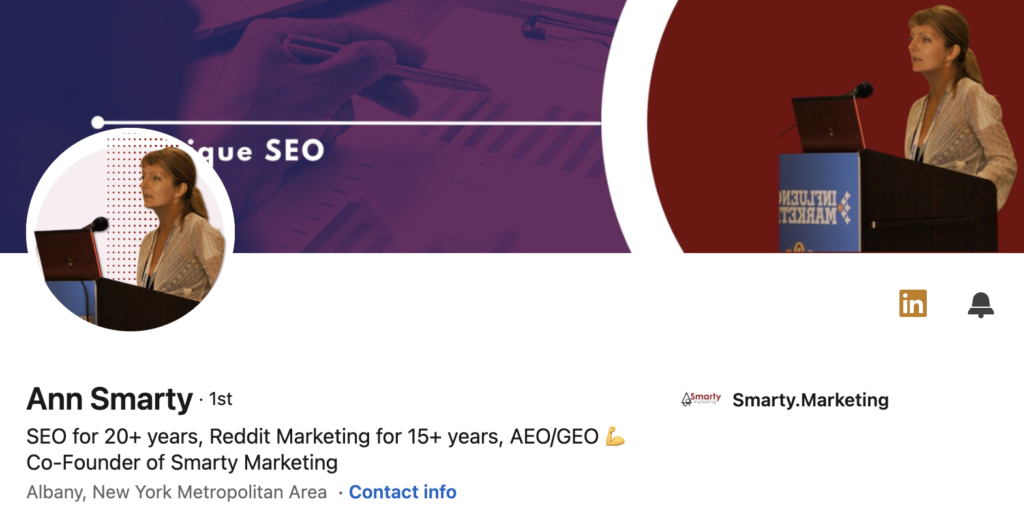
Ann Smarty brings more than 20 years of SEO experience to AI search, but what makes her particularly interesting for this list is her expertise outside the traditional boundaries of a company’s website.
She has been working with Reddit for more than 15 years, long before Reddit became one of the platforms everyone in AI SEO started paying attention to. Today, through Smarty.Marketing, her work combines GEO with Reddit marketing, digital PR, link building, content and broader brand authority.
That combination is increasingly relevant because your website isn’t the only place AI systems can learn about your company. What independent publications, communities, customers and other third parties say about a brand can contribute to the wider information environment surrounding it.
What stands out about her approach:
- More than 20 years of experience in SEO and digital marketing
- 15+ years working with Reddit and online communities
- Strong focus on digital PR and earning third-party editorial coverage
- Combines GEO with link building, content and broader brand authority
- Understands reputation and brand sentiment as part of search visibility
Reddit is a particularly interesting part of that mix. It’s easy to look at the prevalence of Reddit in search results and AI citations and conclude that every company needs to start manufacturing Reddit mentions. That’s not the takeaway.
The value of communities like Reddit is that they contain the kind of independent discussion companies can’t simply reproduce on their own websites: people comparing products, describing problems, recommending alternatives and sharing their actual experiences with brands.
Ann’s long history with the platform gives her a much deeper understanding of how to approach those communities without reducing Reddit to another link-building channel.
Digital PR plays a similar role. Original research, useful data and genuinely newsworthy campaigns can earn coverage across publications that both potential customers and search systems encounter. The result isn’t just more backlinks; it’s a larger body of independent evidence connecting the company with its market, expertise and category.
That’s where I think Ann’s approach is particularly relevant to AI SEO. If the visibility gap exists primarily outside your own domain, endlessly optimizing pages on your website may not address the real problem.
Key strengths: Reddit marketing, digital PR, SEO, GEO, link building, brand authority and off-site visibility.
Best fit: Companies with a solid website and existing search foundation that need to strengthen the external signals, discussions and third-party validation surrounding their brand.
Probably not the best fit: Companies whose primary challenge is highly technical SEO, programmatic SEO or building complex AI-powered SEO automation.
Why I’d choose Ann: When the biggest visibility gap isn’t on the company’s website, but in the wider web of publications, communities and third-party sources that establish whether a brand is known, discussed and trusted.
5. Kenan Mujezinovic
Best for: Companies that want to use AI and automation to make SEO operations more scalable, particularly through programmatic SEO and automated workflows.
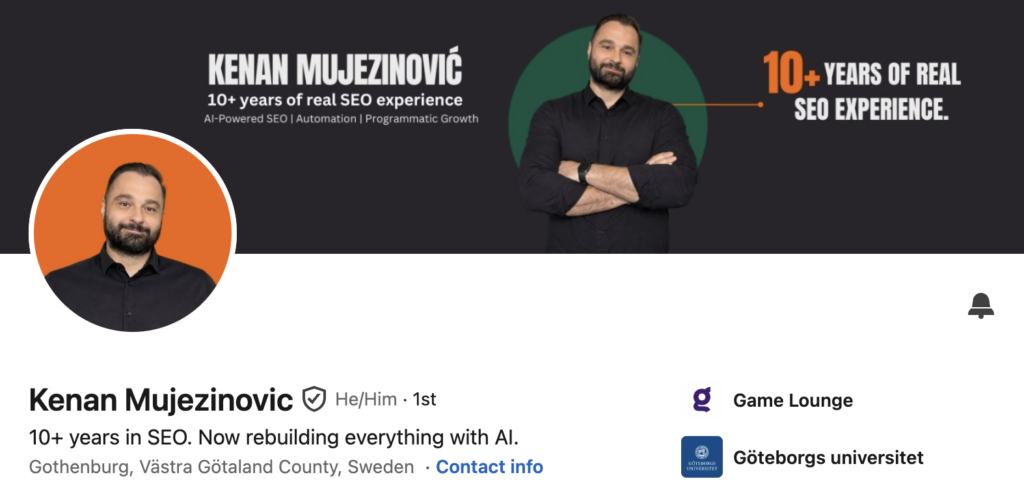
Kenan Mujezinovic brings more than a decade of SEO experience, but his strongest differentiator is how heavily he focuses on using AI to change the way SEO work gets executed.
There’s an important distinction here. Most conversations about AI SEO focus on optimizing for AI platforms: getting mentioned by ChatGPT, cited by Perplexity or included in Google AI experiences. Kenan also works on the other side of the equation: using AI and automation to make the SEO operation itself faster and more scalable.
His work covers AI-powered SEO systems, programmatic SEO and automation using tools such as n8n and Make, with the goal of turning repetitive SEO processes into workflows that can operate much more efficiently.
What stands out about his approach:
- More than a decade of experience in SEO
- Strong focus on AI-powered SEO systems and workflows
- Experience with programmatic SEO and scaling search initiatives
- Uses automation to reduce repetitive SEO work
- Combines newer AI capabilities with established SEO fundamentals
That operational angle is becoming increasingly important.
SEO teams spend a huge amount of time collecting data, clustering keywords, identifying internal linking opportunities, researching content, monitoring performance and moving information between different tools. Many of those processes can now be partially automated or redesigned around AI.
The opportunity isn’t simply to produce more content with AI. In fact, that’s probably one of the least interesting applications.
The bigger opportunity is building systems where machines handle repetitive analysis and execution while humans spend more time on the decisions that actually require judgment: what markets to pursue, which opportunities matter, what should be prioritized and where the data doesn’t support an obvious answer.
Kenan’s work also retains a strong traditional SEO foundation. Automation is a way to execute more efficiently, not a replacement for authority, useful content, technical quality or understanding search intent.
For companies with mature SEO operations, that combination can create substantial leverage. Improving visibility may be the strategic objective, but how efficiently the organization can execute against that strategy determines how much can realistically be accomplished.
Key strengths: AI-powered SEO, automation, programmatic SEO, scalable workflows and traditional search strategy.
Best fit: Companies with meaningful SEO operations that want to increase their execution capacity through AI, automation or programmatic approaches.
Probably not the best fit: Companies primarily looking for digital PR, reputation management or a broader full-funnel demand generation strategy.
Why I’d choose Kenan: When the strategy is reasonably clear but the bigger challenge is building the systems, automation and programmatic infrastructure needed to execute SEO at scale.
6. Cornel Manu
Best for: Post-PMF B2B SaaS companies that want to connect SEO and AI visibility directly with acquisition, conversion and qualified pipeline.
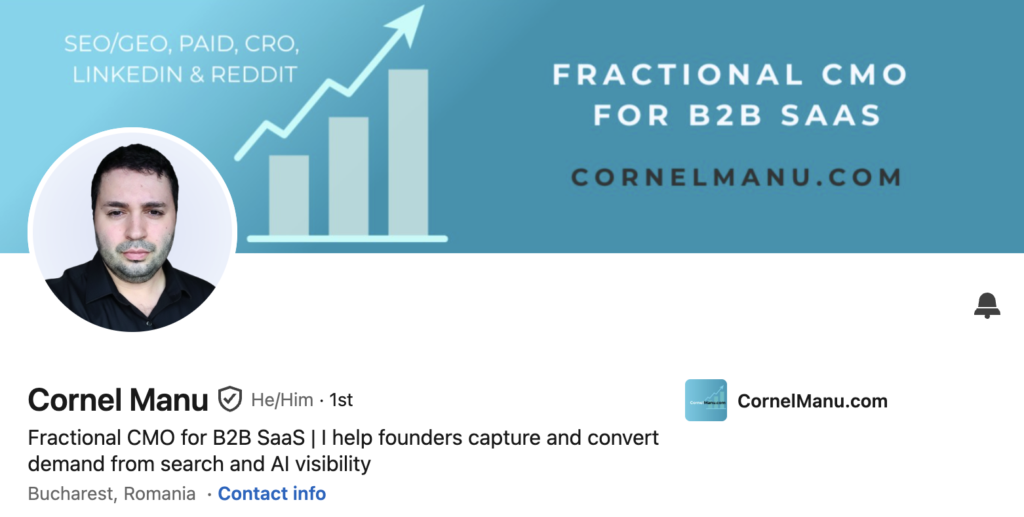
Cornel Manu approaches AI SEO from the perspective of a fractional growth marketer rather than a pure search specialist. His work spans SEO, GEO, paid acquisition, CRO, messaging and lifecycle marketing, with a focus on how those channels work together to generate predictable SQL growth.
That makes him particularly relevant for SaaS companies where the problem isn’t simply visibility.
A company can increase organic traffic, appear more frequently in ChatGPT and improve its share of voice across AI platforms without necessarily creating more revenue. If the positioning is weak, the wrong audience is being attracted or the website fails to convert that demand, additional visibility has limited commercial value.
Cornel’s approach looks further down that funnel.
What stands out about his approach:
- Specializes specifically in post-PMF B2B SaaS
- Connects SEO and GEO with CRO, paid acquisition and lifecycle marketing
- Focuses on pipeline and SQLs rather than traffic or AI visibility alone
- Brings a strong copywriting and messaging background to search strategy
- Works as an embedded growth operator rather than separating strategy from execution
His track record helps illustrate that broader approach. At ivicos, Cornel contributed to scaling the company from roughly €300K to €2M ARR by addressing fragmented acquisition and aligning messaging across channels.
His reported results also include a 358% increase in organic traffic over 12 months, 554 top-10 keyword rankings, a 40% improvement in conversion rate, a 48% increase in activation rate and more than 5,000 MQLs generated.
Those numbers span multiple stages of the funnel, which is precisely the point.
For a SaaS company, AI search doesn’t exist separately from everything that happens before and after it. A prospect might discover the company through ChatGPT, validate it on Google, visit the website and enter a lifecycle sequence before eventually speaking with sales. Optimizing one touchpoint without understanding the rest of that journey can create impressive visibility metrics without fixing the underlying growth problem.
That’s where Cornel’s broader remit becomes useful. He can look at whether the company is being discovered, but also whether its messaging matches the demand being captured, whether landing pages convert it effectively and whether that activity ultimately produces qualified opportunities.
Key strengths: B2B SaaS growth, SEO, GEO, CRO, messaging, paid acquisition, lifecycle marketing and pipeline generation.
Best fit: Post-PMF B2B SaaS companies, particularly those with existing traffic and marketing activity but inconsistent lead quality or pipeline.
Probably not the best fit: Companies looking exclusively for deep technical SEO, digital PR or a highly specialized AI visibility research engagement.
Why I’d choose Cornel: When search visibility is only one part of the problem and the company needs someone to connect discovery with messaging, conversion, acquisition and ultimately qualified pipeline.
7. Gert Mellak, SEOLeverage
Best for: Companies that want to understand and improve their visibility across the entire search journey, including Google, AI platforms, Reddit and YouTube.
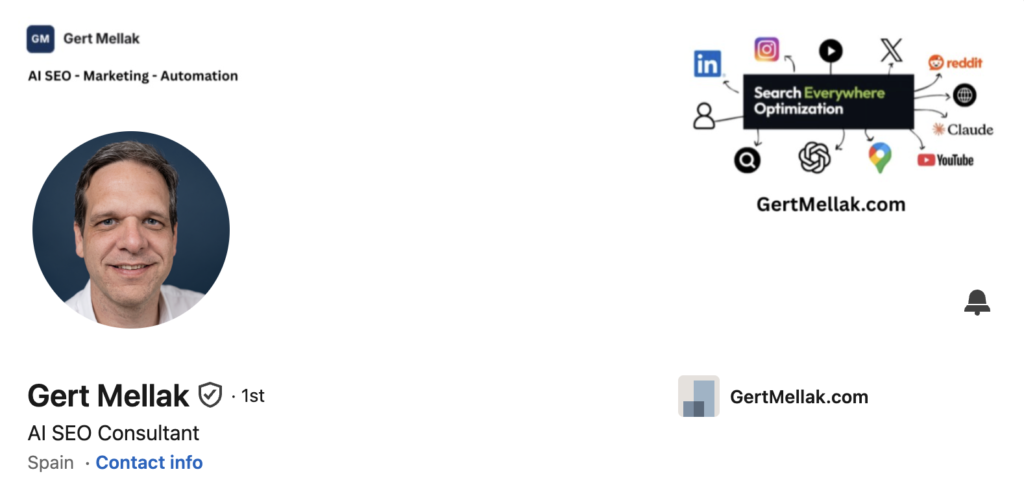
Gert Mellak is the founder of SEOLeverage and brings more than 20 years of experience in SEO and digital marketing. His approach to AI search is built around a broader idea he calls Search Everywhere Optimization.
The premise is simple: customers don’t research companies in one place anymore.
A buyer might discover a category through Google, ask ChatGPT which products they should consider, check Reddit for less polished opinions, watch a comparison on YouTube and use Perplexity to dig deeper before ever speaking with the company.
If your brand is highly visible on Google but absent everywhere else, traditional rankings can give you an incomplete picture of how discoverable you actually are.
What stands out about his approach:
- 20+ years of experience across SEO and digital marketing
- Maps visibility across Google, AI platforms, Reddit, YouTube and other discovery channels
- Looks for gaps across the entire customer research journey rather than optimizing one platform in isolation
- Prioritizes visibility opportunities based on potential commercial impact
- Combines AI search with a strong traditional SEO foundation
One thing I particularly like about this approach is that it reflects how fragmented search behavior has become.
The same customer problem can produce very different information depending on where someone looks. Google might surface comparison pages, ChatGPT might recommend a shortlist of brands, Reddit may strongly favor one product over another, and YouTube could expose the buyer to companies that barely appear in any of the other environments.
Looking at those channels together can reveal something a standalone AI visibility score can’t: where your company disappears from the buying journey.
SEOLeverage’s methodology starts by mapping that visibility and identifying the gaps most likely to matter commercially. Gert also puts an explicit revenue value on these opportunities where possible, which helps move the conversation away from accumulating mentions simply because more visibility sounds good.
That broader perspective makes his work particularly relevant for established companies. If you already have meaningful Google visibility, the next opportunity may not be another ten organic positions. It could be understanding where buyers are researching beyond Google and why competitors are more prominent there.
Key strengths: Search Everywhere Optimization, traditional SEO, AI visibility, cross-platform discovery, Reddit, YouTube and commercial opportunity analysis.
Best fit: Established companies with existing search visibility that want to understand how consistently their brand appears throughout a fragmented customer research journey.
Probably not the best fit: Companies looking primarily for programmatic SEO, highly specialized technical SEO or an engagement focused exclusively on one AI platform.
Why I’d choose Gert: When the real question is broader than “How visible are we in ChatGPT?” and the company needs to understand where it’s winning or disappearing across the different places customers now search and research.
8. Wayne Burden, Alchemy
Best for: Larger companies and complex websites that need AI search integrated into a broader, technically sophisticated SEO program.
Wayne Burden is the co-founder of Alchemy and brings a different perspective to this list: AI visibility as part of a complete organic search strategy rather than a standalone GEO service.
Alchemy’s work spans AI search and LLM optimization alongside technical SEO, content strategy, digital PR, migrations, international SEO and local search. That breadth becomes particularly relevant as the size and complexity of an organization increases.
For a smaller SaaS company, improving AI visibility might be a relatively focused project. For a large organization operating across thousands of pages, multiple markets or complicated technical infrastructure, the problem can involve considerably more moving parts.
What stands out about his approach:
- Combines AI search with deep technical and traditional SEO capabilities
- Experience with large and complex websites
- Covers digital PR and content alongside on-site optimization
- Brings international SEO and website migration expertise
- Treats GEO as an extension of the wider search ecosystem rather than a replacement for SEO
This matters because many of the foundations that affect traditional search haven’t suddenly disappeared.
A company can have an ambitious AI visibility strategy, but technical problems may still prevent important content from being discovered or properly understood. International organizations still need to manage language and market differences. Large websites still create crawling, rendering, architecture and internal linking challenges. And building authority still frequently requires content and digital PR beyond the company’s own domain.
The emergence of AI search adds another layer to that environment rather than removing the existing ones.
That’s where Wayne’s broader SEO background becomes valuable. Instead of starting with the assumption that a company needs a separate set of “GEO tactics,” the work can begin with the wider search problem and determine where AI visibility fits within it.
Alchemy is also part of the Atoms & Space collective, extending the range of specialist capabilities available when an engagement moves beyond the boundaries of a conventional SEO project.
Key strengths: AI search, technical SEO, digital PR, content strategy, international SEO, migrations and complex organic search programs.
Best fit: Established companies with larger or technically complex websites that need AI visibility incorporated into an existing SEO operation.
Probably not the best fit: Smaller companies looking for a narrowly scoped AI visibility experiment or a consultant focused primarily on demand generation and revenue attribution.
Why I’d choose Wayne: When improving AI visibility is only one part of a much larger organic search challenge involving technical infrastructure, content, authority, international markets or a complex existing website.
9. Paul Teitelman, Paul Teitelman SEO Consulting
Best for: Established companies that want to expand a mature traditional SEO strategy into AI search without abandoning the fundamentals that already drive organic growth.
Paul Teitelman has been working in SEO since 2008, bringing 18 years of experience and more than 1,000 campaigns to this list. He founded Paul Teitelman SEO Consulting in 2011 and today leads a team of 15 SEO specialists.
That depth of experience is particularly relevant in AI SEO because not everything we’re seeing today is completely new.
Search has gone through countless changes in how information is discovered, evaluated and ranked. AI platforms represent a significant shift in how people find and compare companies, but many of the underlying concepts around authority, relevance, technical accessibility and useful content still matter.
Paul’s approach combines that traditional search foundation with newer disciplines such as AI SEO, GEO and AEO.
What stands out about his approach:
- 18 years of SEO experience across more than 1,000 campaigns
- Leads a team covering technical SEO, content, keyword strategy and link building
- Combines established SEO practices with GEO, AEO and AI search
- Experience working with both SMBs and major North American brands
- Strong emphasis on authority and trust as foundations for both traditional and AI visibility
His client experience includes companies such as Kijiji, Shoppers Drug Mart, Audible, Bell, Discovery Channel and Toshiba, giving him exposure to search challenges across very different types and sizes of organizations.
Where I think Paul’s experience becomes particularly useful is for companies that already have an established SEO operation.
Those companies don’t necessarily need to throw away years of organic search work and start again with an entirely separate “GEO strategy.” They need to understand which parts of their existing search engine are still creating value, which assets can also support AI discovery, where new visibility gaps are emerging and what genuinely needs to change.
That requires being able to distinguish between established search principles that remain relevant and tactics that are genuinely specific to the new discovery environment.
There’s also a practical advantage to having broader execution capabilities. Improving AI visibility may uncover a technical problem, a content gap, insufficient authority or a need for stronger off-site signals. Having those disciplines available within the same SEO operation can make implementation considerably easier.
Key strengths: Traditional SEO, AI SEO, GEO, AEO, technical SEO, content strategy, link building and long-term organic growth.
Best fit: Established companies with an existing SEO presence that want to adapt their organic strategy to include AI discovery while continuing to strengthen traditional search.
Probably not the best fit: Companies looking primarily for experimental AI visibility research, advanced automation or a broader demand generation engagement beyond search.
Why I’d choose Paul: When a company already has substantial SEO investment and needs someone with deep traditional search experience to help evolve that foundation toward AI discovery rather than treating AI SEO as an entirely separate discipline.
10. Austin Furey, New Chemistry
Best for: B2B companies that want to connect AI search visibility with demand generation, ABM and revenue attribution.
Austin Furey is the founder of New Chemistry and brings a background across B2B growth, SEO, marketing analytics and enterprise account-based marketing.
That combination gives him a useful perspective on AI search because his focus isn’t simply on whether a brand appears in ChatGPT or Perplexity. It’s on understanding where AI search fits within the broader B2B buying journey and how that visibility can be connected back to pipeline.
One of the more interesting parts of Austin’s approach is the idea of mapping a company’s “prompt universe.”
Tracking a handful of obvious prompts like “best CRM software” can tell you something, but it doesn’t necessarily represent how real buyers research a category. Prospects ask different questions depending on the problem they’re experiencing, their role, company size, stage of awareness and where they are in the buying process.
Mapping that wider set of commercially relevant conversations provides a much more useful picture of AI visibility.
What stands out about his approach:
- Strong specialization in B2B and B2B SaaS
- Maps the broader “prompt universe” surrounding a company’s market and buyers
- Combines AI search with SEO, demand generation and ABM
- Brings a strong analytics and attribution background
- Focuses on connecting visibility with pipeline rather than treating citations as the final KPI
That B2B context is particularly important.
A potential customer might use an LLM to understand a problem months before they’re ready to buy anything. Later, they may ask for possible solutions, compare a shortlist of vendors, research specific products and validate those options across Google, Reddit, review platforms and other sources.
A brand can therefore appear at multiple points in the journey, and not every mention carries the same commercial value.
Austin’s approach attempts to understand those different moments rather than collapsing AI visibility into a single score. From there, the work can connect with more established disciplines such as technical SEO, topic strategy, positioning, analytics, demand generation and ABM.
His analytics background also becomes useful when the conversation moves from visibility to impact. Attribution from AI search is still imperfect, particularly when LLMs influence a decision without generating a direct referral visit. But companies still need to move beyond counting mentions and start understanding whether increased AI visibility is influencing discovery, consideration and eventually pipeline.
Key strengths: AI search, B2B SEO, prompt strategy, demand generation, ABM, marketing analytics and revenue attribution.
Best fit: B2B and B2B SaaS companies that want to understand AI visibility across the full buyer journey and connect it with their broader go-to-market strategy.
Probably not the best fit: Companies primarily looking for international SEO, digital PR, Reddit specialization or large-scale programmatic SEO automation.
Why I’d choose Austin: When the priority is understanding which AI conversations actually matter to B2B buyers and connecting visibility across those conversations with ABM, demand generation and revenue measurement.
Which AI SEO consultant should you choose?
As the profiles above show, there isn’t really a universal “best AI SEO consultant.” The right choice depends on the problem you’re trying to solve, the maturity of your search program, and where the biggest gaps in your visibility actually are.
For a B2B SaaS company trying to understand why competitors are outperforming it across LLMs and traditional search, I’d start with Growth Forensics.
If AI search needs to sit inside a broader demand generation strategy, Fatmir Hyseni is particularly strong. For Spain and Spanish-speaking markets, Juan Carlos Trueba Santana brings deeper international and technical specialization. If the opportunity is primarily around Reddit, digital PR and off-site authority, Ann Smarty stands out.
Kenan Mujezinovic is a better fit when automation or programmatic SEO is central to the project, while Cornel Manu makes sense when AI visibility needs to connect with CRO, acquisition and pipeline. Gert Mellak takes an even broader approach to discovery across Google, LLMs, Reddit and YouTube.
For larger organizations with complex technical SEO requirements, Wayne Burden is particularly relevant. Paul Teitelman brings nearly two decades of SEO experience for companies that want to evolve an established organic search program toward AI discovery, while Austin Furey is a strong option for B2B teams that need AI search tightly connected with ABM, demand generation and attribution.
The important distinction is that the consultants above aren’t ten interchangeable “GEO experts.” They approach AI search from different parts of the search, brand and customer acquisition ecosystem.
Before choosing one, I’d start by identifying the actual problem: Are competitors being recommended more often? Are you missing from the third-party sources shaping your category? Is your traditional search presence strong but failing to translate into AI visibility? Or are you already earning visibility but struggling to connect it with commercial results?
The answer should narrow the field considerably.
AI SEO Consultant vs. Agency vs. In-House: Which Do You Actually Need?
Hiring an AI SEO consultant isn’t necessarily the right answer for every company. Before choosing someone from the list above, it’s worth asking a more fundamental question: what kind of help do you actually need?
A consultant, agency, fractional lead, and in-house hire can all work on AI search, but they solve different organizational problems.
| Option | Best when | Main advantage | Main limitation |
|---|---|---|---|
| AI SEO consultant | You need specialist expertise, diagnosis or, a strategy your existing team can execute | Direct access to senior expertise and flexibility | Limited execution capacity |
| AI SEO agency | You need strategy and significant ongoing execution | Access to multiple specialists and greater production capacity | Usually more expensive and senior involvement can vary |
| Fractional SEO / AI Search lead | You need someone to own the function without hiring full-time | Becomes embedded in the business and can coordinate multiple teams | More expensive than advisory consulting and still part-time |
| In-house hire | Search and AI visibility are important enough to require permanent ownership | Deep product, customer and organizational knowledge | Requires enough ongoing work to justify a full-time specialist |
a. When a consultant makes the most sense
A consultant is usually strongest when the constraint is expertise rather than manpower.
For example, your existing SEO or marketing team may already be capable of creating content, making technical changes and running campaigns. What it lacks is a methodology for understanding why competitors are appearing across LLMs, which prompts matter commercially, what external signals should be investigated and which opportunities deserve investment.
In that situation, hiring an entire agency can be unnecessary. A consultant can diagnose the problem, establish the measurement framework, develop the strategy and work with the people already inside the company to execute it.
Consultants can also make sense for defined projects: an AI visibility audit, competitive analysis, strategy development, experimentation, training or an independent review of what an existing SEO team or agency is doing.
The tradeoff is capacity. One senior consultant can’t simultaneously produce large volumes of content, run digital PR campaigns, implement technical changes, build automation and manage every other component of a large search program.
b. When an AI SEO agency makes more sense
An agency becomes more attractive when execution capacity is the bottleneck.
If the strategy requires technical SEO, content production, digital PR, outreach, reporting and AI visibility monitoring to happen simultaneously, having several specialists available can be much more practical than expecting one consultant to coordinate everything.
This is particularly relevant for companies without an established internal SEO team. A great diagnosis isn’t very useful if nobody has the capacity to implement the recommendations.
The tradeoff is that “agency” doesn’t automatically mean deeper expertise. You should understand who is actually developing the strategy, who will work on the account day to day, and how much access you’ll have to the senior people whose experience influenced the buying decision.
c. When a fractional lead makes sense
A fractional SEO or AI Search lead sits somewhere between consulting and hiring someone permanently.
Instead of advising on a specific problem and leaving the company to execute, a fractional lead typically takes ongoing ownership of the search function. They may build the roadmap, prioritize initiatives, coordinate content and engineering, manage external agencies or freelancers and report performance back to leadership.
For a growing B2B SaaS company, this can be useful when search has become strategically important but there isn’t yet enough need, budget or organizational maturity for a full-time Head of SEO or AI Search.
The distinction is essentially advice versus ownership. A consultant can tell you what should happen. A fractional lead is more likely to be responsible for making sure it happens.
d. When you should build the capability in-house
Eventually, some companies reach the point where search is too important to remain primarily external.
An in-house specialist develops knowledge that’s difficult for an external provider to replicate: how customers describe the product, which objections repeatedly appear in sales calls, how the buying process works, what engineering can realistically implement and where the company is heading strategically.
That context becomes increasingly valuable as AI search moves closer to brand positioning, product marketing and the wider customer journey.
The downside is specialization. AI SEO already touches traditional SEO, technical infrastructure, content, digital PR, analytics, communities and brand. Finding one employee who’s genuinely excellent at all of those things is unrealistic.
For larger organizations, the best model may therefore be hybrid: internal ownership of search strategy and company knowledge, supplemented by consultants or agencies when specialist expertise or additional execution capacity is needed.
How to Evaluate an AI SEO Consultant
AI SEO is still new enough that evaluating a consultant can be difficult. Case studies are limited, methodologies vary significantly, and results are inherently noisier than looking at whether a page moved from position eight to position three on Google.
That makes the way a consultant thinks about the problem particularly important.
If I were evaluating someone, I wouldn’t start by asking which GEO tactics they use. I’d give them my company, a few competitors, and an important customer problem, then ask how they would figure out why those competitors are being recommended and we aren’t.
Their answer should tell you a lot.
1. How do they decide which prompts actually matter?
Tracking hundreds or thousands of prompts can create an impressive dashboard without producing much useful information.
The prompts being monitored should represent real problems, use cases and buying situations relevant to your customers. “Best project management software” might matter, but so might “How can I keep a remote team organized across different time zones?” if that’s a problem your product solves.
A good consultant should be able to explain how they build that prompt set and why each group of queries matters commercially.
They should also understand that prompt wording introduces variability. Measuring one exact query once and treating the response as a ranking is a weak methodology.
2. Can they establish a reliable baseline?
Before anyone claims to have improved your AI visibility, you need to know what it looked like before the work started.
That baseline might include recommendation frequency, mentions, relative position, competitor share of voice, citations and visibility across different customer problems. It should also cover multiple relevant systems rather than assuming ChatGPT represents the entire AI search market.
Repeated measurements matter here. LLM outputs are probabilistic, so running a prompt once and saving the result isn’t enough to establish that Company A definitively ranks above Company B.
The methodology should account for that volatility rather than hide it.
3. Do they analyze traditional search alongside AI search?
I’d be skeptical of an AI SEO strategy that completely ignores Google.
Traditional search remains an important discovery channel, but it can also help us understand the information environment surrounding an LLM response. The pages ranking for relevant queries, the brands appearing within those pages and the sources occupying the SERP can provide useful context when investigating why certain companies repeatedly surface in AI recommendations.
This doesn’t mean Google rankings directly determine LLM recommendations. That’s exactly the kind of causal assumption we should avoid.
It means the two environments should be studied together rather than pretending AI search appeared in a vacuum.
4. Do they investigate what happens outside your website?
If an AI SEO audit mostly produces recommendations for your own pages, I’d want to know why.
Your website is important, but it’s only one source of information about your company. Competitors may have stronger representation across comparison articles, industry publications, Reddit, YouTube, review platforms, directories and other third-party sources.
A consultant should be capable of investigating that wider footprint and identifying meaningful differences between the companies that consistently earn visibility and those that don’t.
Otherwise, AI SEO quickly becomes traditional on-page SEO with a different name.
5. Can they distinguish correlation from causation?
This is one of the most important questions in AI SEO right now.
Imagine the companies dominating AI recommendations also have more backlinks, branded searches, G2 reviews, Reddit mentions, and YouTube videos than everyone else. All of those signals might correlate with AI visibility, however, that doesn’t tell us which ones caused it.
Large successful companies tend to accumulate many positive signals simultaneously, making it difficult to isolate what actually influences an LLM recommendation. A consultant should understand this problem and avoid turning every correlation into a ranking factor.
The useful next step is forming hypotheses and looking for ways to test them.
6. How do they approach experimentation?
Once a potential visibility gap has been identified, ask what happens next.
A useful process should look something like this: establish the baseline, identify a meaningful difference between winners and losers, form a hypothesis about why that difference might matter, make a targeted intervention, and measure whether the outcome changes.
The result won’t always be clean. AI search has too many variables for every experiment to establish causality.
But the consultant should at least be trying to learn from interventions rather than implementing a fixed list of supposed best practices and assuming they worked.
7. How do they measure success?
More mentions can be a useful leading indicator, but they shouldn’t automatically be the final KPI. Ask what happens after visibility improves.
Can AI referral traffic be measured? Are branded searches changing? Are more visitors arriving through high-intent discovery journeys? Are leads or signups coming from AI platforms? Can any influence on pipeline be observed?
Attribution is imperfect, particularly when someone discovers a company through an LLM and later returns through Google or direct traffic. A consultant shouldn’t pretend otherwise.
But commercial measurement should at least be part of the conversation.
8. What do they do when they don’t know?
This might be the question I’d value most. Ask a consultant what they would do if, after analyzing your company and its competitors, they couldn’t confidently explain why another brand was being recommended more frequently.
The right answer isn’t to invent an explanation.
AI search is young, LLMs are opaque, and there are still major gaps in what we understand about how brands are retrieved, cited and recommended. “I don’t know yet, but here’s how I’d investigate it” can be a much stronger answer than an immediate 30-point GEO checklist.
The consultants worth paying attention to aren’t necessarily the ones claiming to have AI search figured out. They’re the ones with a rigorous enough methodology to keep learning as the evidence changes.
How Should You Measure AI SEO Performance?
Measuring AI SEO is more complicated than tracking rankings. In traditional SEO, we have mature metrics such as rankings, impressions, clicks, organic traffic and conversions. AI search introduces another layer where a company can influence a buying decision without generating a click at all.
Someone might ask ChatGPT for software recommendations, discover your company there, and Google your brand two days later. Another buyer might use an LLM to narrow ten vendors down to three before visiting any of their websites.
In both cases, AI search influenced discovery or consideration. Neither journey necessarily appears as an AI referral in your analytics.
That’s why AI SEO measurement needs to happen at several levels.
1. AI visibility metrics
The first layer is understanding whether your company actually appears in the conversations that matter.
Useful metrics can include:
- Mention rate: How frequently your brand appears across a defined set of prompts
- Recommendation rate: How often the brand is explicitly presented as a solution or option
- Share of voice: How your visibility compares with competitors across the same prompt set
- Recommendation position: Where the brand tends to appear when multiple companies are suggested
- Prompt coverage: How many relevant problems, use cases and buying situations trigger your brand
- Model consistency: Whether visibility exists across ChatGPT, Gemini, Claude, Perplexity and other relevant systems
- Citation visibility: Which websites and sources are being referenced alongside recommendations
These metrics provide a useful baseline, but they need context. A 20% increase in mentions isn’t particularly meaningful if the additional prompts have little commercial relevance.
The goal isn’t to maximize the number of prompts where your company appears. It’s to increase visibility in the conversations that could realistically influence customers.
2. Search and discovery metrics
The next layer is understanding what happens around those AI recommendations.
AI search doesn’t operate separately from the rest of the web. A buyer who encounters your company in ChatGPT may subsequently search for the brand on Google, read reviews, visit Reddit or watch a product comparison before reaching your website.
That means measurement should also consider signals such as:
- Referral traffic from AI platforms
- Branded organic search demand
- Traditional organic visibility for relevant categories and use cases
- Presence within third-party pages ranking for commercially important searches
- Visibility across comparison sites, review platforms, Reddit and YouTube
- Changes in direct and branded traffic that coincide with increased AI visibility
None of these metrics independently proves that AI search caused the change. But looking at them together provides a much more complete picture than an LLM visibility score in isolation.
3. Business impact
This is ultimately the layer that matters. For B2B SaaS companies, increased visibility should eventually contribute to outcomes such as qualified website visits, signups, demos, opportunities, pipeline or revenue.
Some of that can be measured directly. If ChatGPT sends a visitor to your website and that visitor requests a demo, the journey is relatively easy to identify.
Other influence is much harder to capture.
A decision-maker might discover three vendors through an LLM, research all three independently and eventually arrive at your website through a branded Google search. Standard last-click attribution will probably credit Google even though AI played an important role in creating the consideration set.
That means companies may need to combine direct attribution with other evidence: self-reported attribution on lead forms, sales conversations, branded search trends, CRM data and changes in visibility across the customer journey.
The objective isn’t to manufacture perfect attribution where it doesn’t exist. It’s to get closer to understanding whether improved visibility is producing commercial value.
4. Don’t reduce everything to one AI visibility score
A single score can be useful for reporting trends, but it can also hide important information. Imagine two companies both have an AI visibility score of 60.
One is mentioned across hundreds of informational prompts but rarely recommended when users are actually comparing products. The other appears less frequently overall but consistently gets recommended for a small group of high-intent buying situations.
Those companies don’t have equivalent visibility.
The same problem applies when aggregating different models, prompts and recommendation positions into one number. The simplicity makes reporting easier, but it can remove the context needed to make decisions.
AI visibility should therefore be treated as a collection of signals rather than one definitive KPI.
The measurement chain I’d ultimately want to understand is:
AI visibility → discovery and consideration → website or brand engagement → qualified pipeline → revenue
We won’t always be able to connect every step perfectly.
But that’s the direction the measurement should be moving in.
Red Flags When Hiring an AI SEO Consultant
AI SEO is moving quickly, and that creates an obvious problem: it’s relatively easy to sell certainty in a field where there’s still a lot we don’t understand.
That doesn’t mean companies should wait until every aspect of AI search has been figured out. It does mean you should be skeptical of anyone presenting an overly simple explanation of how LLM visibility works.
Here are some of the biggest red flags I’d watch for.
a. Guarantees of ChatGPT rankings or recommendations
Nobody can guarantee that ChatGPT, Gemini or another LLM will recommend a particular company for a particular prompt.
Results can vary between runs, models change, retrieval systems evolve, and we don’t have access to the complete systems determining which companies appear.
A consultant can improve the conditions surrounding your visibility. They can identify gaps, run experiments and measure whether recommendations become more frequent. That’s very different from guaranteeing a ranking.
b. Claiming to know the exact AI SEO ranking factors
Be cautious when correlation is presented as settled fact.
We can observe relationships between AI visibility and signals such as brand authority, search visibility, backlinks, third-party mentions, reviews or presence within certain sources. Determining exactly how much each signal contributes to a recommendation is considerably harder.
The more confidently someone presents a universal list of “ChatGPT ranking factors,” the more I’d want to see the evidence behind it.
c. Treating schema as an AI SEO strategy
Structured data can be useful for helping machines understand information on a website, but adding schema isn’t a complete strategy for becoming a recommended brand.
If competitors have significantly stronger authority, broader third-party coverage, better category associations and more evidence supporting their position in the market, adding another schema type to your homepage probably isn’t going to close that gap.
e. Looking only at your website
If an AI SEO audit barely examines anything outside your domain, that’s another warning sign.
Your website is one part of the information ecosystem surrounding your company. Publications, comparison pages, review platforms, communities, videos and other third-party sources can contain information about your brand and competitors that your own website can’t provide.
A useful competitive analysis should try to understand that wider environment.
f. Using screenshots as proof of performance
A screenshot showing your company being recommended by ChatGPT is evidence that it happened once. It isn’t evidence that you now “rank #1 on ChatGPT.”
AI responses vary, which means performance needs to be measured across repeated runs, relevant prompt variations and, ideally, multiple models. Without that context, it’s very easy to selectively show favorable outputs.
g. Tracking lots of prompts without explaining why they matter
More tracked prompts don’t automatically produce better measurement.
A dashboard monitoring 5,000 questions can be less useful than one monitoring 100 carefully selected prompts tied to real customer problems and buying situations.
Ask how the prompt set was created and what commercial behavior it’s intended to represent.
h. Applying the same GEO checklist to every company
Different companies lose visibility for different reasons.
One might have weak technical foundations. Another may lack third-party authority. A third might be widely known but associated with the wrong use case. Another may already have strong visibility but no idea whether it contributes to revenue.
The diagnosis should determine the strategy, not the other way around.
i. Treating AI mentions as the final outcome
More mentions are useful if they increase the probability that relevant customers discover and consider your company.
But the objective for a B2B SaaS company isn’t to collect ChatGPT mentions. It’s to create commercially valuable visibility.
A good AI SEO consultant should be interested in what happens after the mention: whether the company enters more consideration sets, attracts relevant demand and, eventually, whether that visibility contributes to pipeline and revenue.
The common thread across most of these red flags is certainty without enough evidence. AI SEO doesn’t require guessing, but it does require being clear about what we know, what we can measure, what we can reasonably infer and what still needs to be tested.
AI SEO Is Still Being Figured Out
Traditional SEO has had more than two decades of experimentation, patents, leaks, case studies, tooling and collective knowledge behind it. AI SEO doesn’t have anything close to that history yet.
We can observe which brands get recommended, analyze the sources LLMs rely on, compare the characteristics of companies that consistently win visibility, and test how results change across models, prompts and use cases. That gives us plenty to work with, but not enough to turn every correlation or successful experiment into a universal rule.
I don’t see that uncertainty as a reason for companies to ignore AI search. Quite the opposite.
Buyers are already using LLMs to discover products, understand categories, compare alternatives and research companies. The behavior is here even if our understanding of how to influence it is still developing.
What I don’t think companies should do is treat AI SEO as a replacement for traditional SEO.
Search behavior is fragmenting rather than moving cleanly from one platform to another. Someone might discover a category through ChatGPT, Google the companies they were recommended, check Reddit for opinions, watch a comparison on YouTube and only then visit a vendor’s website. Another buyer might start on Google, encounter an AI Overview and continue the rest of their research inside an LLM.
The result is a much broader definition of search visibility.
For years, the central SEO question was largely about getting the right pages in front of people searching for the right things. That still matters. But companies now also need to understand whether their brands are present in the information environments customers use to research a market, and whether AI systems recognize them as relevant options when those customers ask for help.
That requires looking beyond rankings and beyond LLM mentions in isolation.
The questions I’m most interested in are how those two layers of search visibility interact, what actually causes companies to gain or lose visibility across them, and whether being more discoverable ultimately puts a company into more buying decisions.
Because that’s where this all needs to end.
A #1 Google ranking is a means to an end. A ChatGPT recommendation is a means to an end. An AI visibility score is a means to an end.
The business outcome is what matters.
That’s also what I’d look for when choosing anyone from this list. Not someone who claims to have discovered the definitive GEO playbook, but someone who understands search deeply, has a rigorous way of investigating what is happening, and is willing to change their assumptions when the evidence changes.
AI SEO doesn’t have a finished playbook yet.
For now, the people doing the most valuable work are the ones helping to figure out what belongs in it.